logotype
Donate
HFHI – BMZ II
Habitat Updates

Understanding GEDSI: Equal Rights and Equal Opportunities in Community Development in Nglipar

Gunungkidul, July 9, 2026 – “I used to think gender referred only to a group of widows. I was once invited to join a group that called itself a gender group. I wondered, ‘I thought gender meant widows, so why is this woman included when she isn’t a widow?’ That was my first understanding of the term. It turns out I was wrong,” said Agus Suwarjo, Head of Pengkol Village, Nglipar District, Gunungkidul Regency, during his opening remarks at the Sinau Bareng Warga: Gender Equality, Disability, and Social Inclusion (GEDSI) Mainstreaming event held at the Pengkol Village Hall.

The concepts of gender and GEDSI are still relatively unfamiliar in Pengkol and the wider Nglipar area, particularly among participants of the Sinau Bareng Warga program. Some participants initially understood gender simply as the biological difference between men and women.

“As far as I knew, gender was just the difference in sex between men and women before I joined this activity,” said Iqbal Nur, a representative of the local Youth Organization (Karang Taruna) and one of the 15 participants.

After participating in the Sinau Bareng Warga: GEDSI Mainstreaming program—a collaboration between Habitat for Humanity Indonesia, SPEK-HAM, and SAPDA through the ACCESS Program—Iqbal gained a broader understanding of the concept. He learned that gender is a social construct associated with men and women, with roles and expectations that are shaped by society and can change over time.

Iqbal also shared that the training helped him realize that everyone has equal rights and equal opportunities, regardless of whether they are men or women. While biological sex cannot be changed, the social roles and expectations assigned to men and women are shaped by society and can evolve.
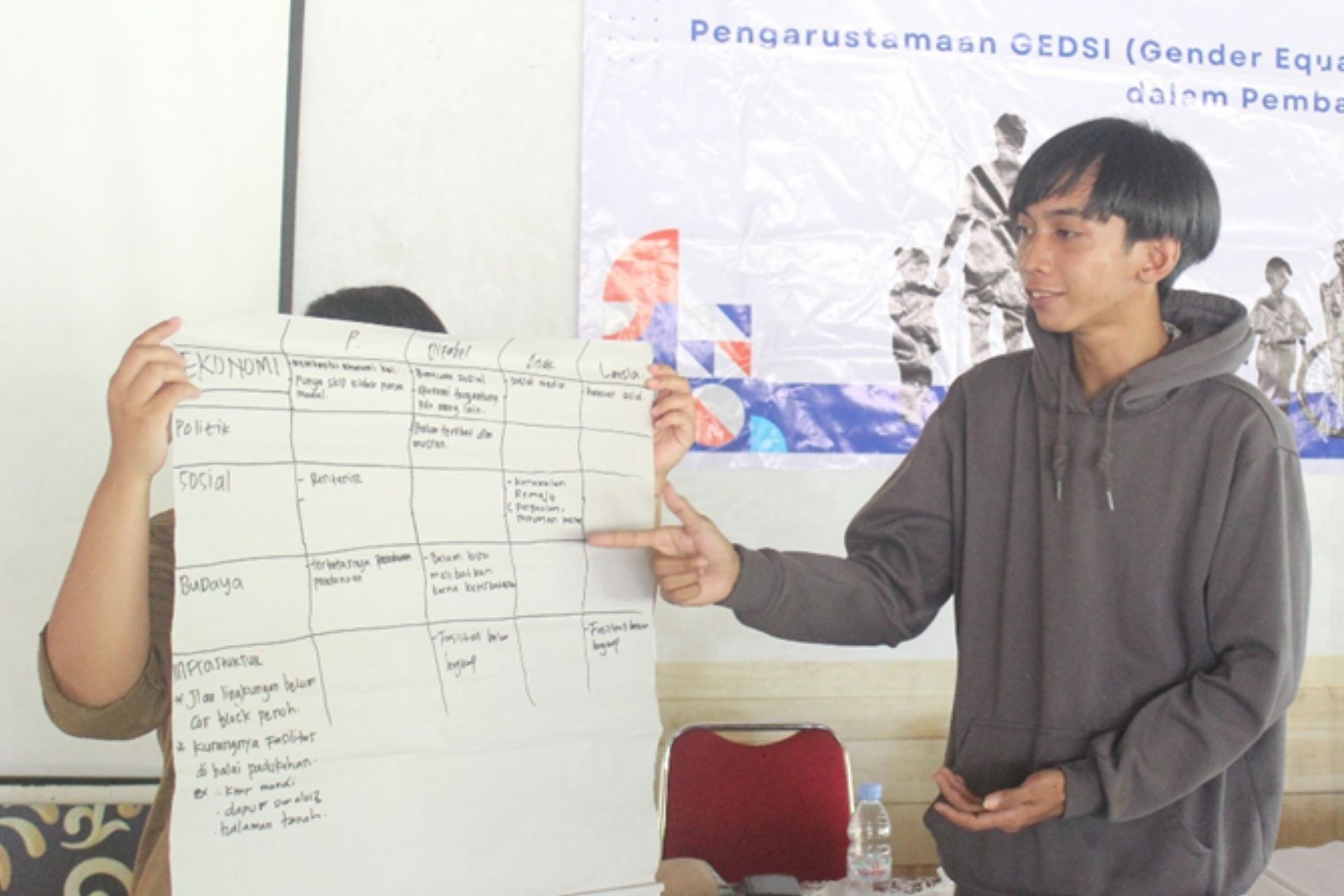
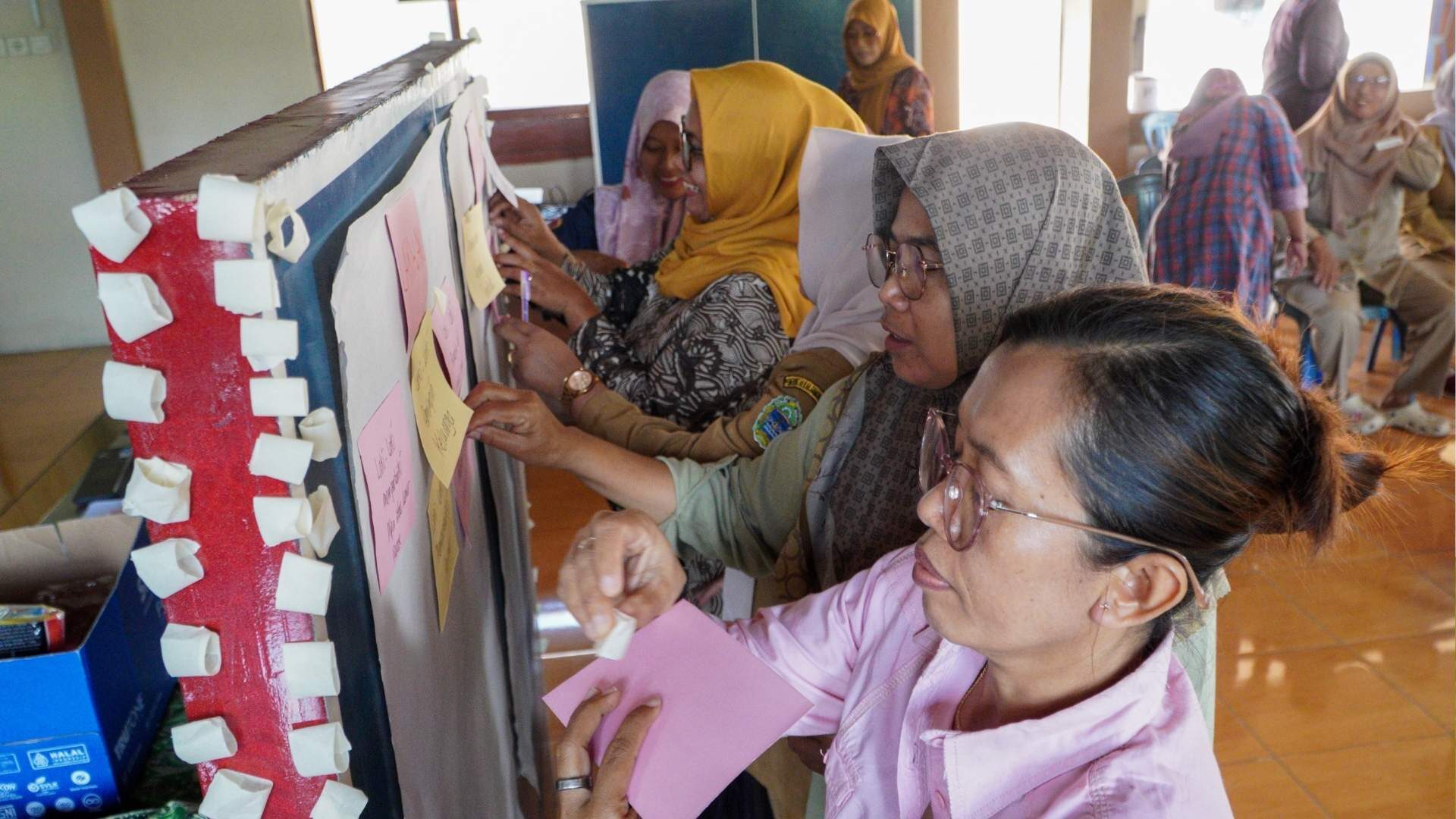
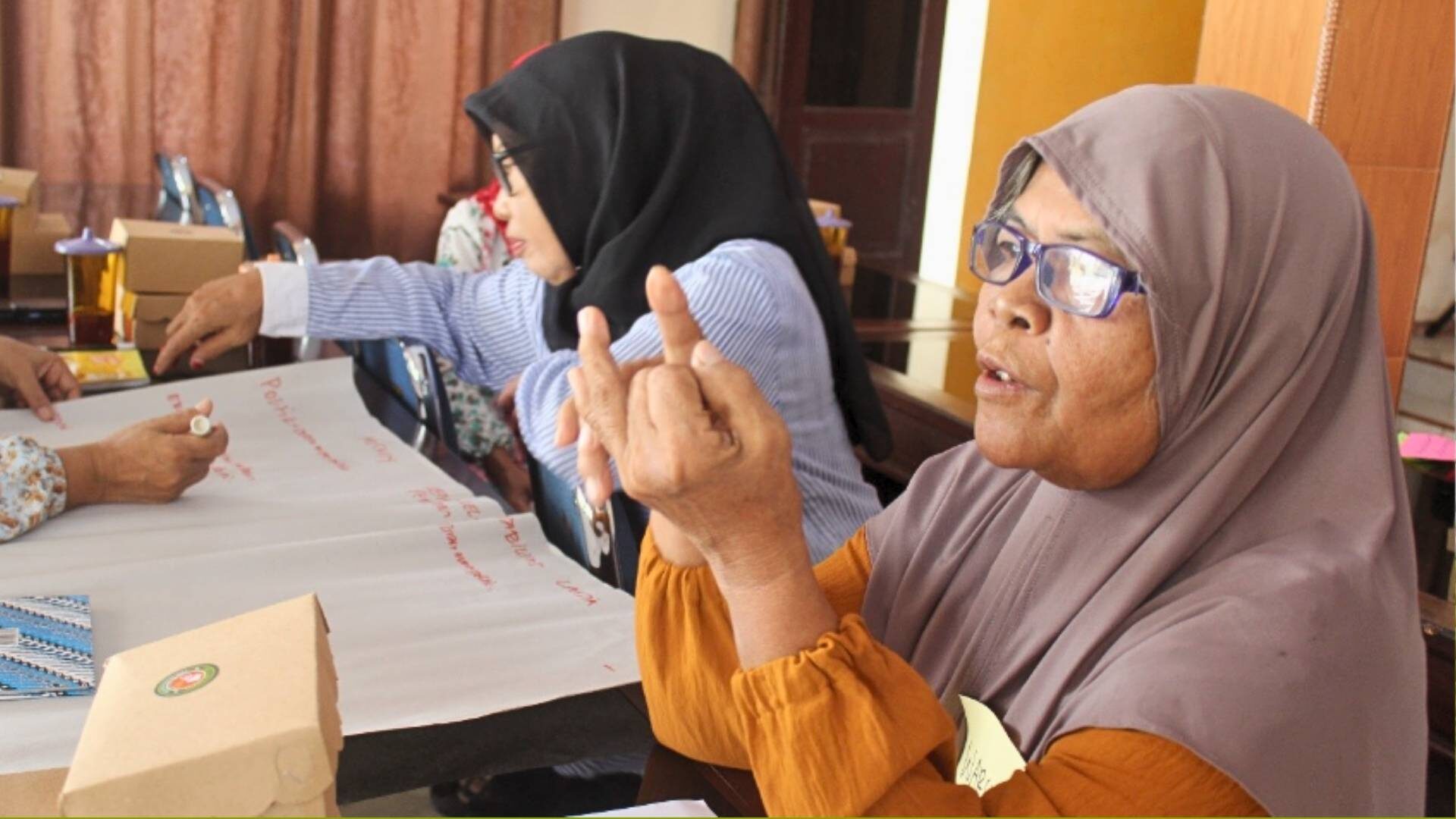
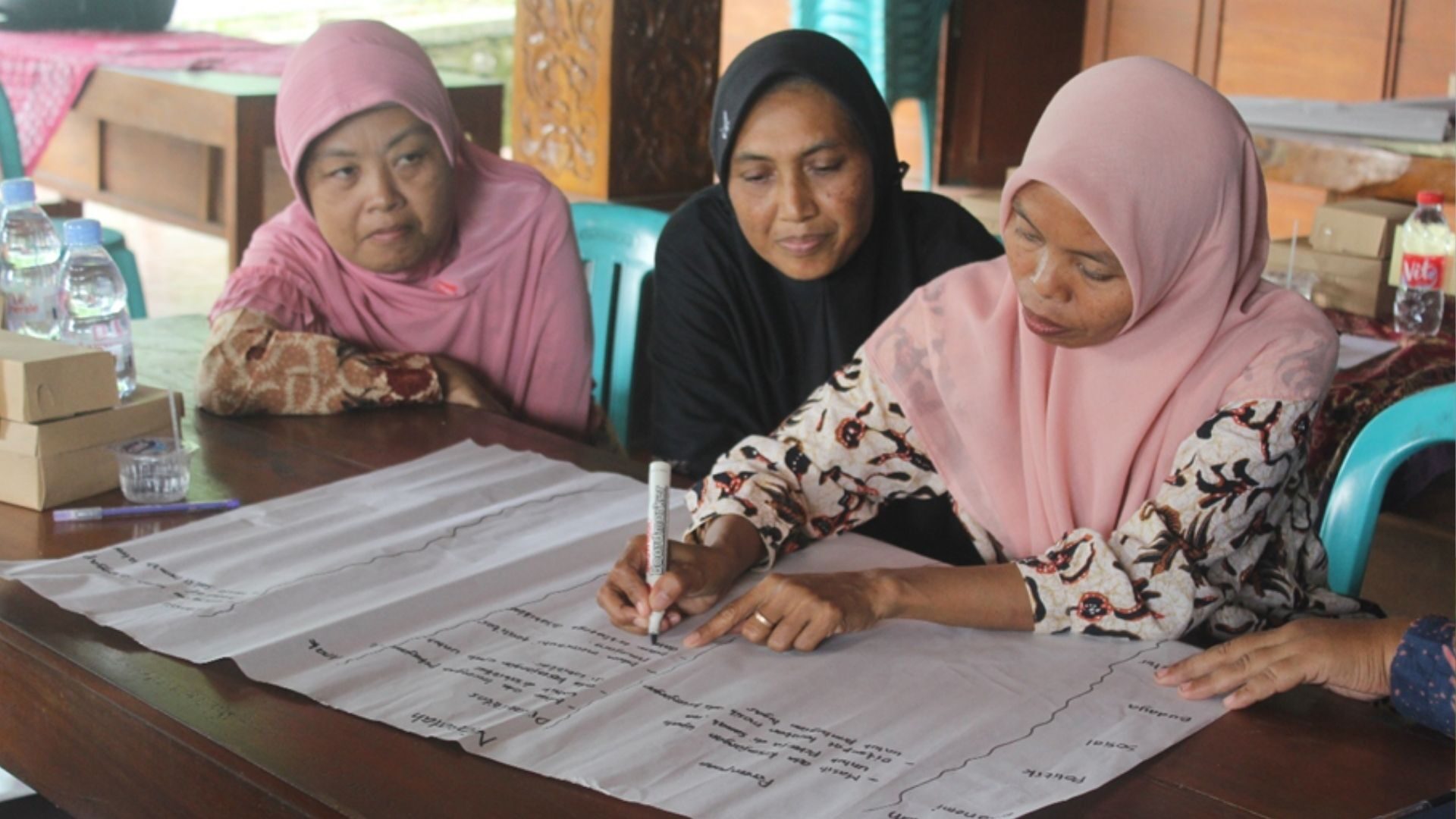
Participants of the Sinau Bareng Warga program present the results of mapping the challenges and potential of their villages in Gunungkidul Regency, Indonesia.

Read also: Promoting Inclusive Development at the Community Level Through Shared Learning Spaces

In the context of development, Amin Nurohman, one of the resource persons for the Sinau Bareng Warga sessions held in Pengkol and Pilangrejo Villages, explained that understanding gender means recognizing that both women and men should have equal opportunities to participate in and benefit from development.

“When it comes to development, there should be equal economic opportunities. If assistance is provided, everyone should have equal access to it. If roads are built, both women and men should equally benefit from safe and reliable infrastructure,” Amin explained.

The same principle applies to access to clean water. Both women and men have the equal right to access and benefit from clean water services.

The participation of representatives from various community groups in Nglipar—including the Women’s Farmer Group (KWT), the Family Welfare Movement (PKK), the Youth Organization (Karang Taruna), disability groups, the Empowerment of Women Heads of Households (PEKKA), hamlet heads, vulnerable groups, and other community organizations—is expected to strengthen the identification of both community challenges and local potential. Their active involvement also provides valuable input to village development planning forums, enabling local governments to promote more inclusive and equitable development for everyone.

Photo & Writer: SAPDA/Wulan Dwi

(av/kh)
HFHI
Stories of Change

Yanto’s Story from the Foothills of Bondowoso, Enduring Life in a Fragile Home

For many people, the sound of rain can be soothing. But for Yanto, every raindrop falling on the roof of his former home brought nothing but anxiety.

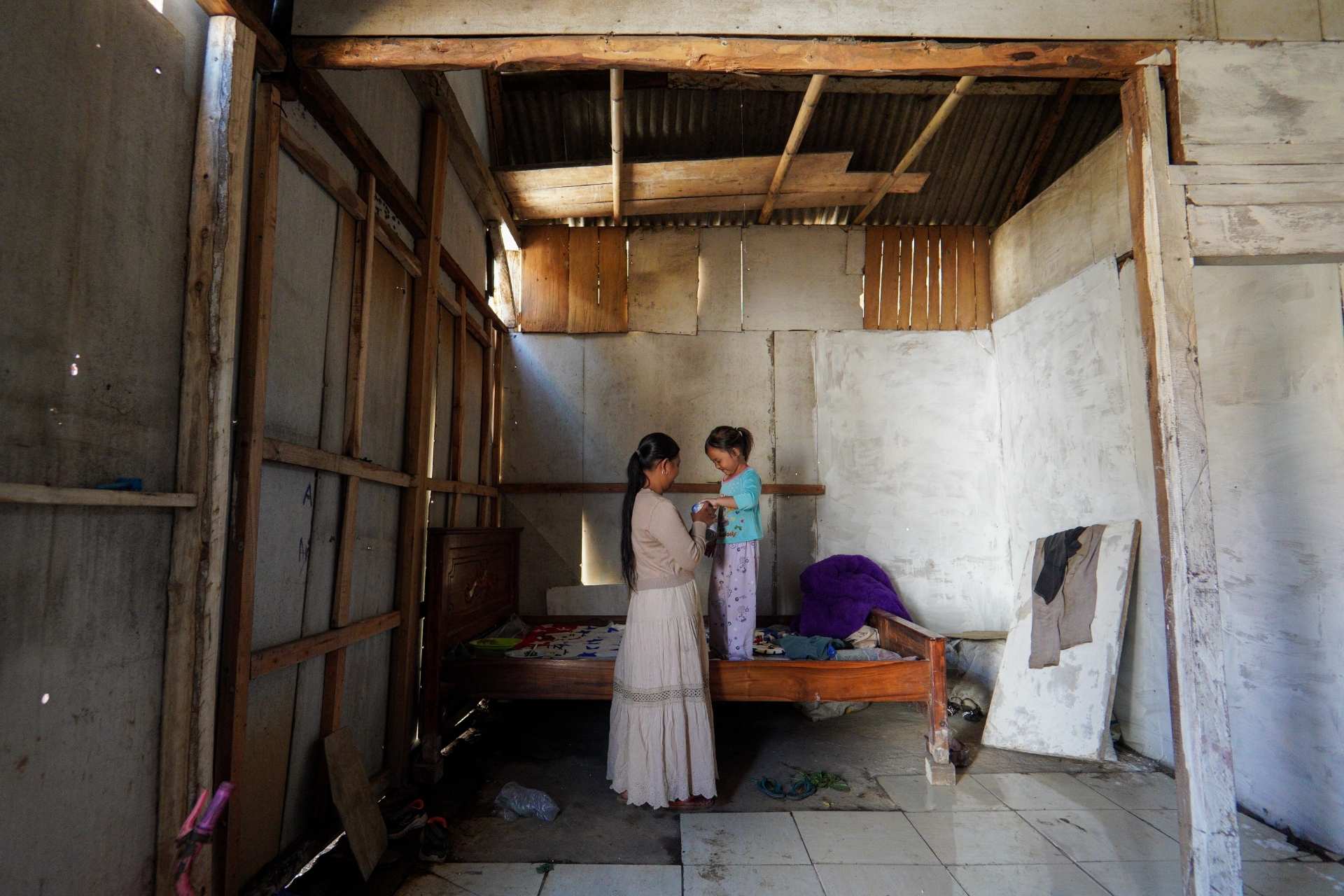
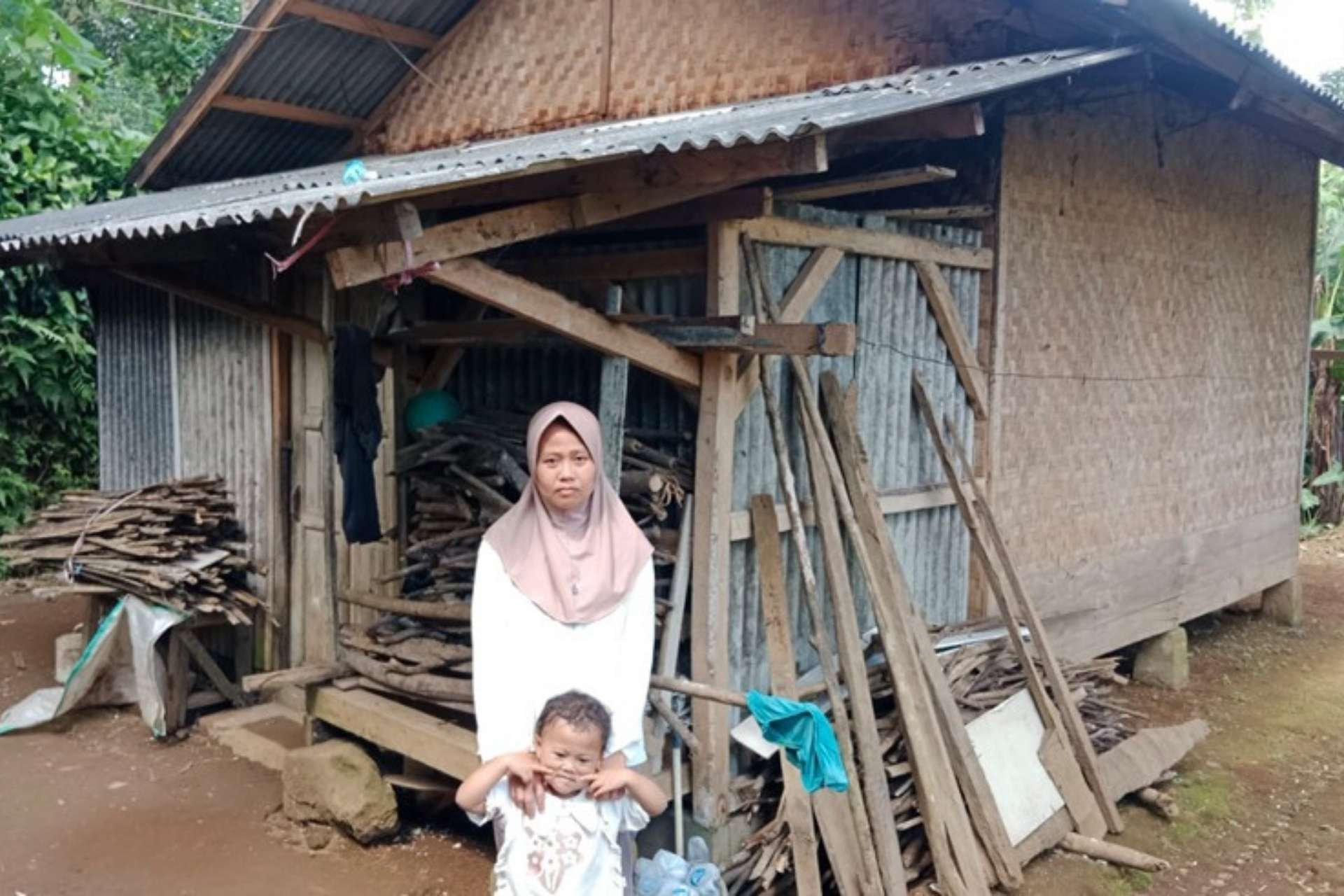
Bondowoso, July 7, 2026 – For nearly ten years, the 34-year-old resident of Sumberwringin, Bondowoso Regency, lived with his family in a modest house that had steadily deteriorated with age. The floor was still made of bare earth, the walls were constructed from plywood sheets that had become weathered and full of holes, and the asbestos roof above them was riddled with gaps that allowed rainwater to pour into the house.

“The roof used to leak, and there were holes everywhere along the edges. When it rained heavily, water would come in and everything inside would get wet,” Yanto recalled.

As an odd-job laborer earning around IDR 50,000 per day, Yanto had very few options. Most of his income was spent covering daily necessities for his wife and their six-year-old daughter. Whenever there was any money left over, food for the family remained the top priority.

“We had to be very frugal. If we weren’t, we wouldn’t have enough to meet our daily needs,” he said.

Living in a mountainous area brought its own challenges. At night, cold air would enter the house from all directions. Wind passed through the holes in the walls, while the damaged roof could no longer provide proper protection. Yanto and his family relied solely on blankets to keep warm.

Amid all these hardships, the thing that troubled him most was the safety of his family.

“I felt sad, sometimes even to the point of crying when I looked at the condition of the house. But what could I do? I didn’t have the money to repair it. As long as we had enough to eat, that was what mattered most,” he said.

His worries grew whenever he imagined the worst possible scenario. The aging house made him fear that a disaster or earthquake could cause the structure to collapse. At the same time, the asbestos roof was another source of concern, as the material is known to pose health risks, especially for children who spend their days living and growing up beneath it.

Yanto’s wife and daughter are inside their inadequate home in Bondowoso Regency, Indonesia. Photo: HFHI/Kevin Herbian

Read also: Seven Years Waiting for a Decent Home: Nining’s Struggle to Care for Her Parents Amid Hardship

In the midst of these difficult circumstances, Yanto never imagined that his life would change.

Then one day, a team from Habitat for Humanity Indonesia visited his home to conduct an assessment.

At first, he assumed it was simply a routine survey. However, he was shocked to learn that his family had been selected to receive support for the construction of a decent home.

Yanto did not let the opportunity pass him by. Throughout the construction process, he actively participated in any work he could do. From digging the septic tank and carrying building materials to assisting with various construction tasks, he contributed wherever possible.

For Yanto, the house was not something that simply appeared. It was built with his own labor, time, and dedication throughout the construction process.

The transformation he experienced was remarkable.

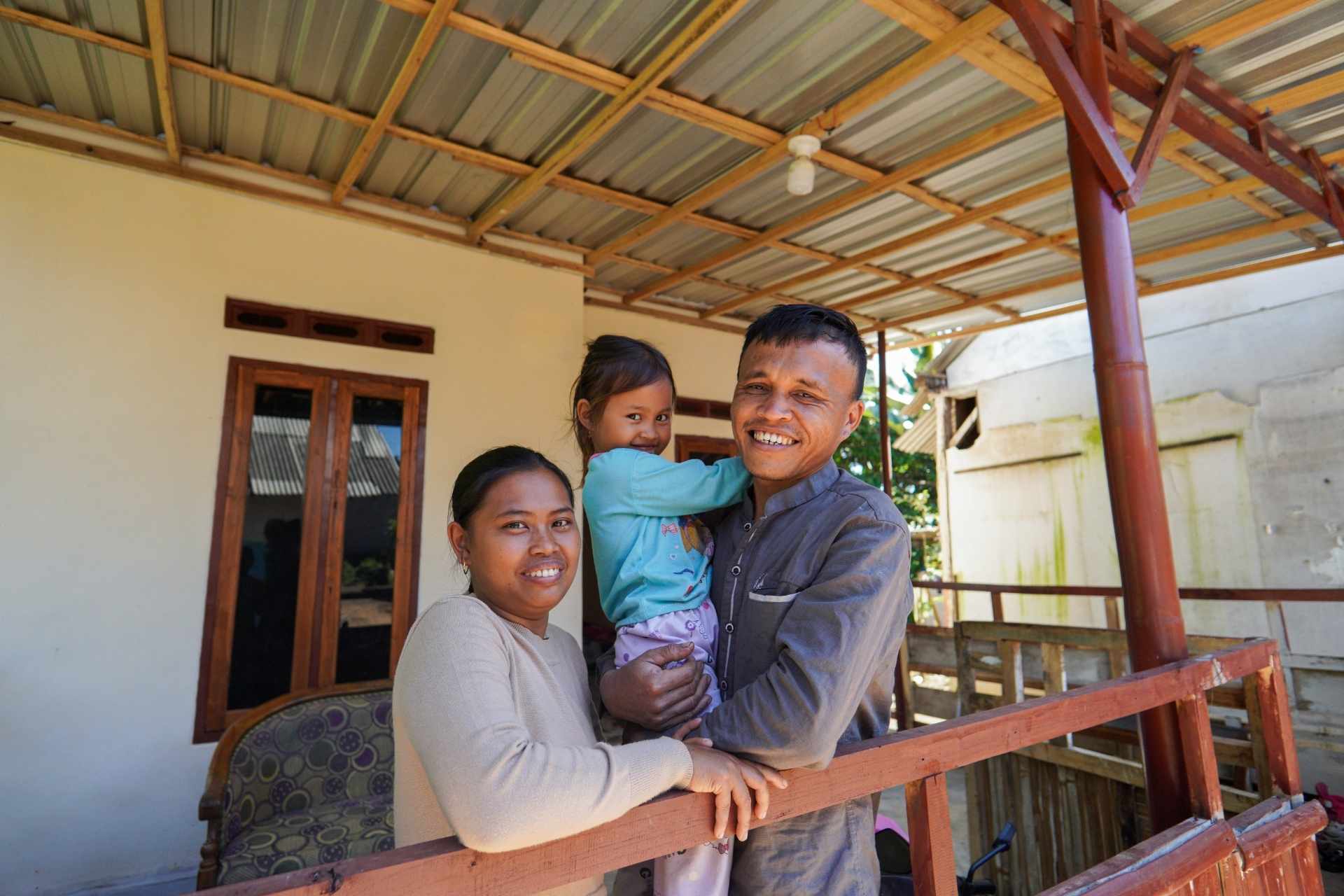
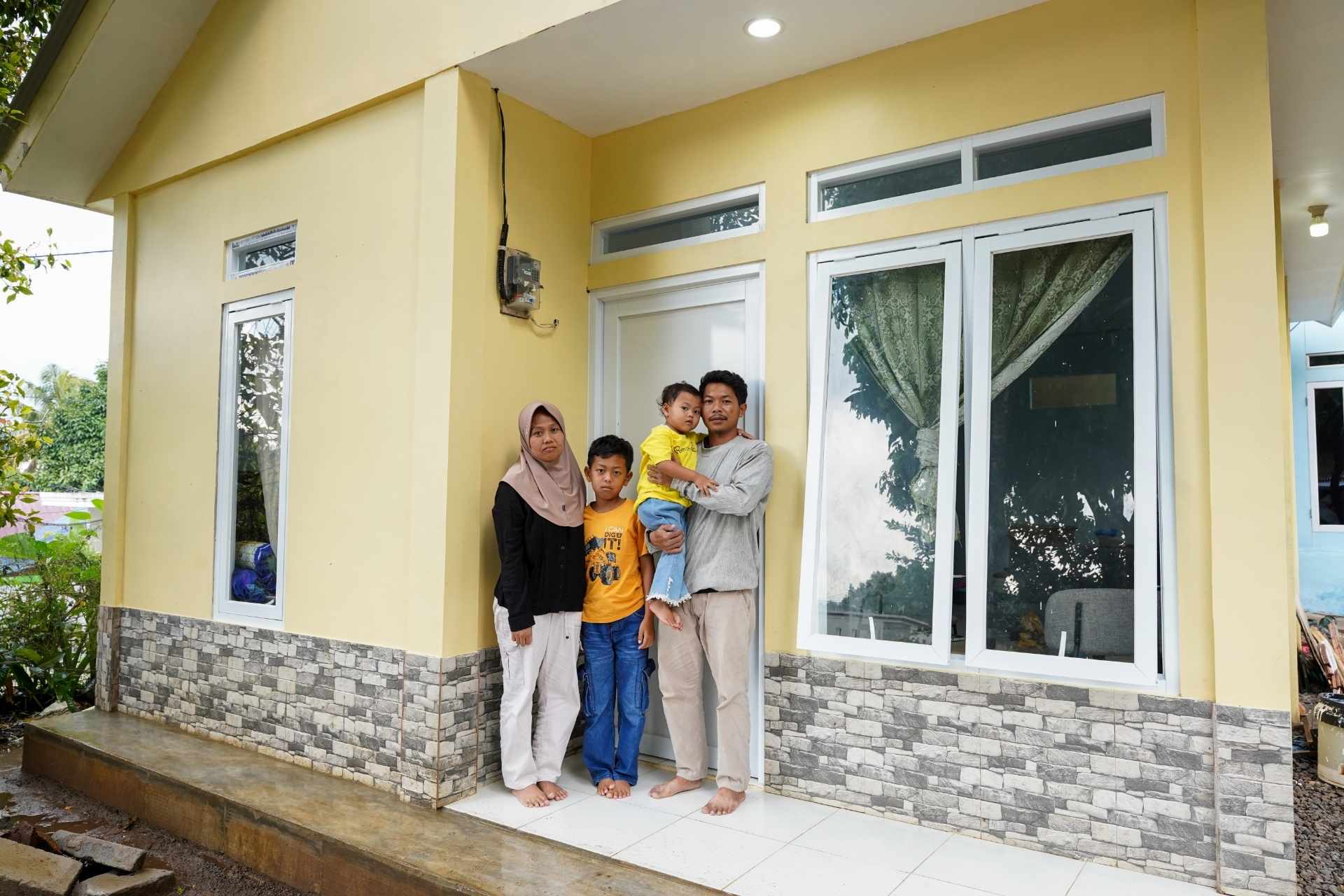
Today, his home looks completely different. Cream-colored walls have replaced the fragile materials of the past, while the stronger structure provides the sense of security he had dreamed of for years.

“My wife and daughter are very happy now. There are no more leaks. I’m no longer afraid that the house might collapse,” he said with a relieved smile.

A portrait of Yanto’s family standing on the porch of their now decent home, made possible by the support of donors through Habitat for Humanity Indonesia in Bondowoso Regency, Indonesia. Photo: HFHI/Kevin Herbian

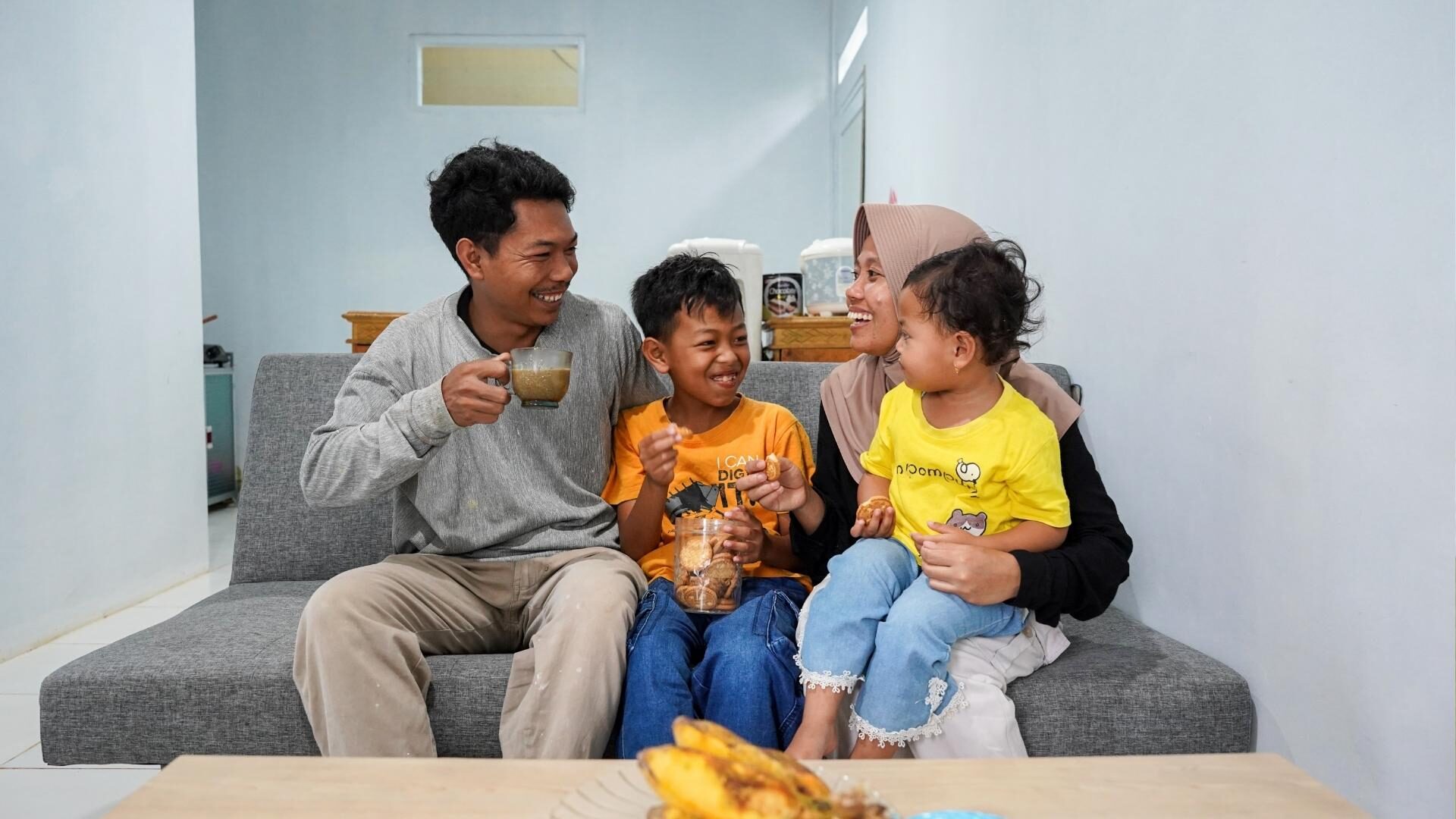
The impact extends beyond the physical condition of the house. Yanto has also seen positive changes in his family’s daily life. His wife and daughter can now rest comfortably without having to endure cold air seeping through gaps in the walls. They also no longer live under an asbestos roof that had long been a source of concern.

His daughter has grown into a happier and more cheerful child. The safer yard around their home now gives her space to play and explore her surroundings.

“In the past, I often stopped her from playing too much. I was worried the house was too unsafe or that she might get hurt. Now she can play freely wherever she wants,” Yanto said.

The nights that were once filled with worry have gradually been replaced by peaceful rest. There is no longer overwhelming anxiety whenever it rains or when strong mountain winds blow.

That peace of mind has given Yanto renewed energy to continue working and to look toward the future with greater optimism. He can now focus on things that were previously overshadowed by concerns about the house, including preparing for his daughter’s education.

For Yanto, this transformation is about more than simply having a safer place to live. It is an opportunity to live with greater peace of mind, care for his family more effectively, and move forward with confidence that the future he dreams of for his daughter is now much closer than ever before.

Writer: Kevin Herbian

(kh/av)

HFHI – BSPS
Habitat Updates

Habitat for Humanity Indonesia and Sragen Regency Government Join Forces to Improve Housing Conditions for 101 Families

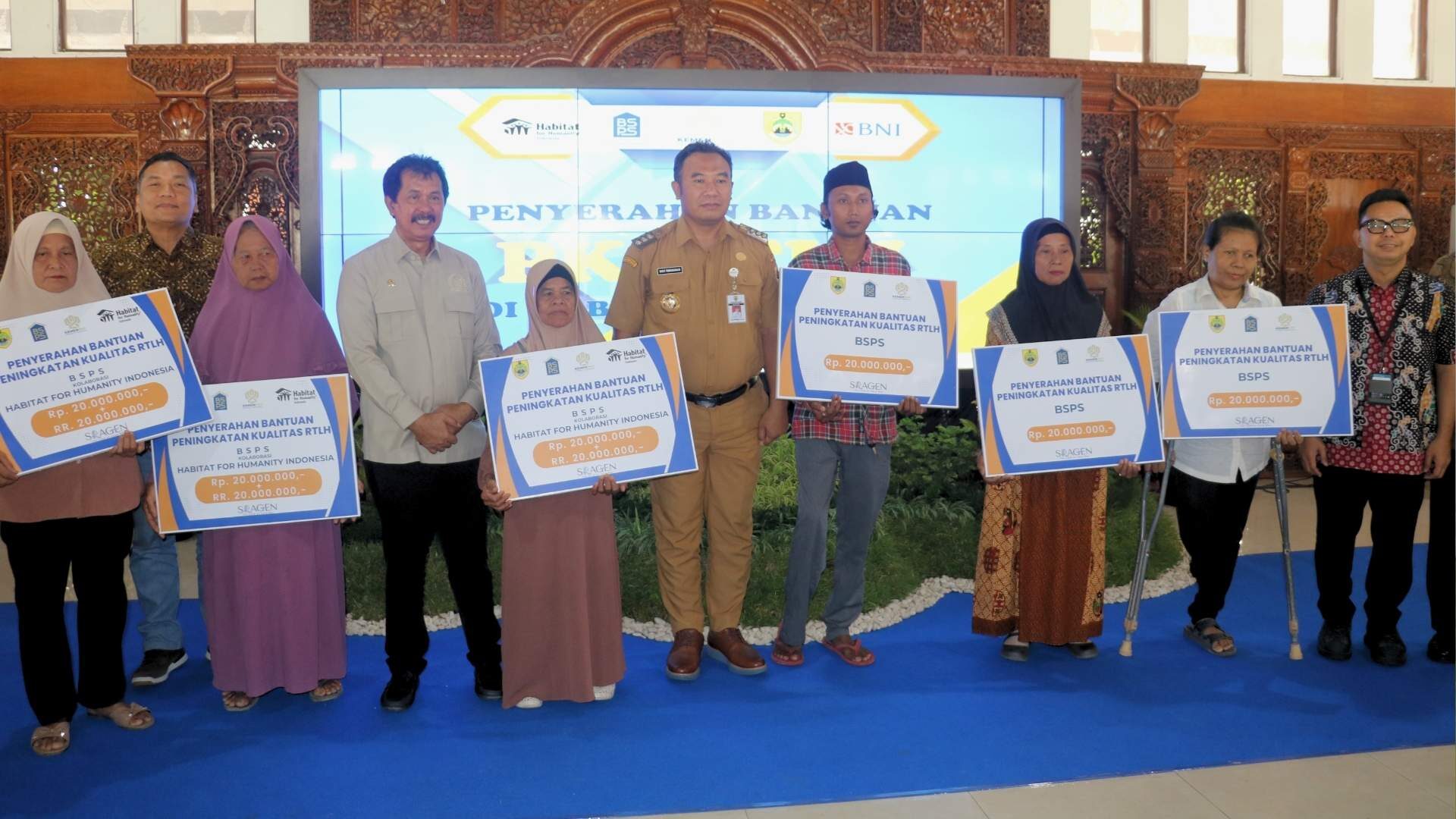
Sragen, June 30, 2026 – Habitat for Humanity Indonesia and the Sragen Regency Government continue to strengthen their collaboration to improve access to decent housing for low-income families. This commitment was marked by a ceremonial handover of assistance for the improvement of substandard housing (Rumah Tidak Layak Huni – RTLH), held at the Sumonegaran Pavilion in Sragen Regency. 

The assistance was symbolically presented by the Regent of Sragen, Sigit Pamungkas; the Head of BP3K Central Java Region III, Aldino Herupriawan; Member of Commission V of the Indonesian House of Representatives, Sriyanto Saputro; and Rudi Nadapdap, Senior Manager of Field Operation at Habitat for Humanity Indonesia. The event marked a collaborative effort between the local government and Habitat Indonesia to support the provision of safer, healthier, and more adequate housing for families in need. 

The collaboration focuses on reaching families in the first and second income deciles, female-headed households, and families with members living with disabilities. Throughout 2026, the program aims to build and improve homes for 101 families out of the 904 families identified as priorities by the Sragen Regency Government. 

This partnership was established in response to the significant need for adequate housing in Sragen Regency. According to data from the Sragen Regency Government, the region has one of the highest poverty rates in the Solo Raya area and is among the eight poorest regencies in Central Java. Out of a total population of 1,021,435, approximately 110,650 people—or 12.41 percent—still live below the poverty line. 

These challenges are also reflected in the housing sector. A total of 13,945 families in the first and second income deciles continue to live in substandard housing. Among them are 3,229 female-headed households, 1,912 families with members living with disabilities, and 2,151 families that remain part of the housing backlog. 

Read also: Collaborating for Decent Housing: Addressing the Housing Backlog Challenge in Sragen

To address these challenges, Habitat for Humanity Indonesia has partnered with the Sragen Regency Government through a matching-fund scheme that complements the government’s Self-Help Housing Stimulant Assistance Program (Bantuan Stimulan Perumahan Swadaya – BSPS). Under this scheme, the government’s contribution of IDR 20 million is matched by an additional IDR 20 million from Habitat Indonesia’s donors, enabling each beneficiary family to receive more comprehensive support to meet the standards of decent housing. 

Throughout the implementation of the program, beneficiary families are not required to make financial contributions. Instead, they contribute through sweat equity by participating in the construction process. Habitat Indonesia also provides comprehensive technical assistance, including project planning, construction supervision, material management, and quality assurance to ensure that each house meets the specific needs of the family, while also considering accessibility for persons with disabilities and safety for female-headed households. 

Beyond improving the physical condition of homes, the program also strengthens community capacity through Building Back Safer (BBS) training. The training equips families with knowledge of safer and more disaster-resilient construction practices. In addition, advocacy initiatives—including workshops and public awareness campaigns—are conducted to promote greater public understanding of the importance of inclusive and sustainable decent housing. 

Through this collaboration, Habitat for Humanity Indonesia and the Sragen Regency Government hope that more families will be able to live in safe, healthy, and decent homes while strengthening joint efforts to reduce housing poverty across Sragen Regency. 

(kh/av)

HFHI – Arada
Habitat Updates

GEDSI Training: Strengthening Clean Water Management and Inclusive Housing in Panggang District, Gunungkidul Regency

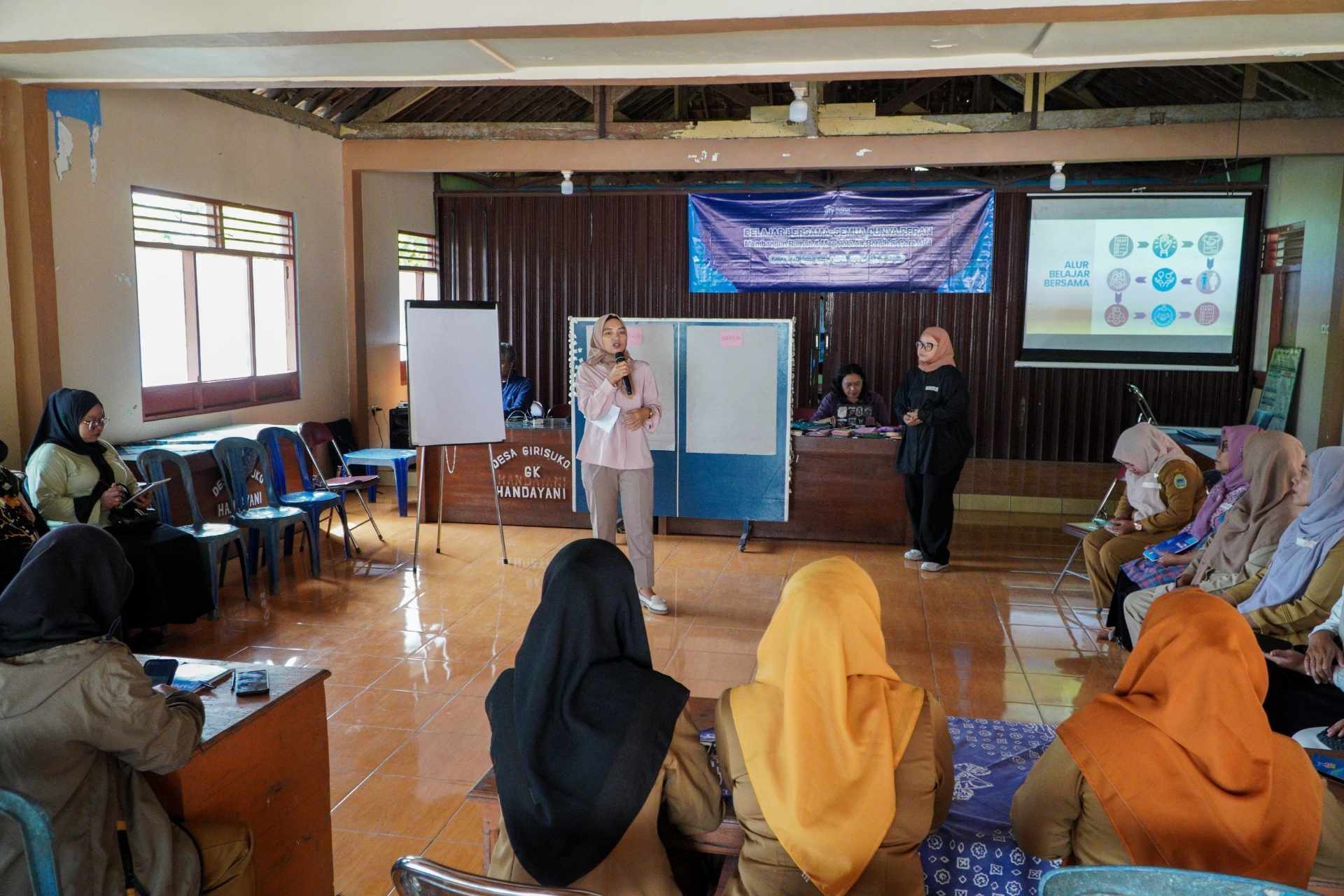
Gunungkidul, June 29, 2026 – Access to clean water and decent housing is often considered a basic need that is already evenly distributed. However, realities on the ground show otherwise. Not all groups in society have equal opportunities to access, use, or participate in decision-making related to these services. This situation forms the background of the Gender Equality, Disability, and Social Inclusion (GEDSI) Basic Training on Clean Water Management and Inclusive Housing in Panggang District, Gunungkidul Regency.

In this region with karst geographical characteristics, access to clean water becomes an increasingly serious challenge during the dry season. However, its impacts are not experienced equally. Women, older persons, and persons with disabilities often face greater burdens, ranging from limited access to mobility barriers in obtaining water and other basic services. At the same time, their participation in community-level decision-making processes remains limited.

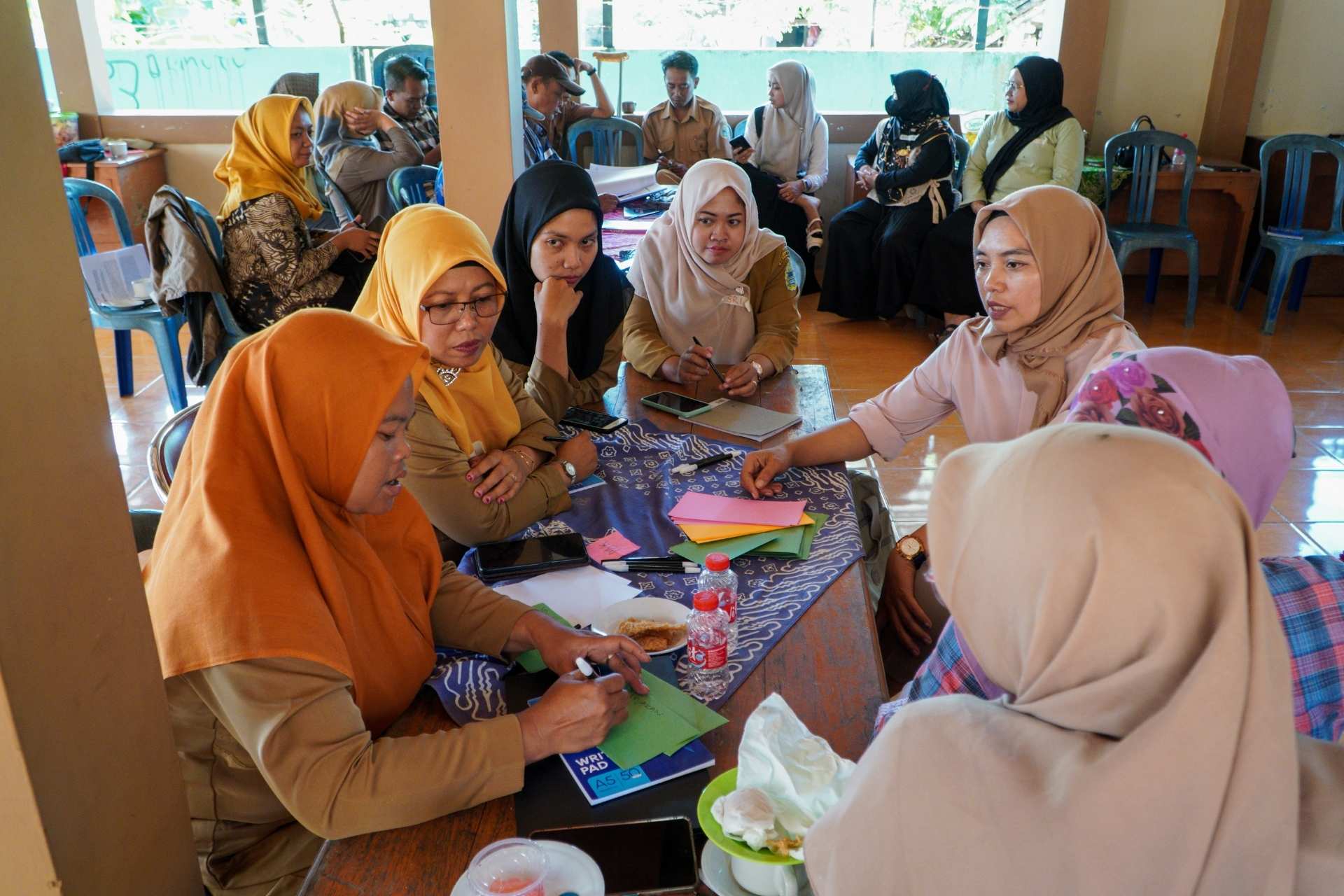
A total of 23 community representatives, consisting of village officials, female heads of households, older persons, and representatives of families of persons with disabilities, participated in this training. Through a participatory approach, participants were encouraged to understand inequality in access, map existing conditions in the field, and explore how village decision-making can become more inclusive through various simulations and interactive discussions.

From this process, participants began to see that water and housing issues are not only about infrastructure, but also about who is involved, who is affected, and who is still underrepresented. The GEDSI approach opens up reflection that sustainable development must consider access, control, benefits, and participation fairly for all groups in society.

This training marks an important step in strengthening community understanding and capacity to be more responsive to the needs of vulnerable groups. The hope is that these inclusive practices can continue to be applied in village-level planning and resource management so that development can truly be felt by everyone without exception.

Come and see their activities in the photos below.

The Village Secretary, Wahyu Setyoningsih, delivered the opening remarks for the Gender Equality, Disability, and Social Inclusion (GEDSI) Training on Water Management and Inclusive Housing in Kapanewon Panggang, Gunungkidul Regency. In her speech, she emphasized the importance of collaboration among all community elements in creating more inclusive and equitable water management and housing systems for everyone.

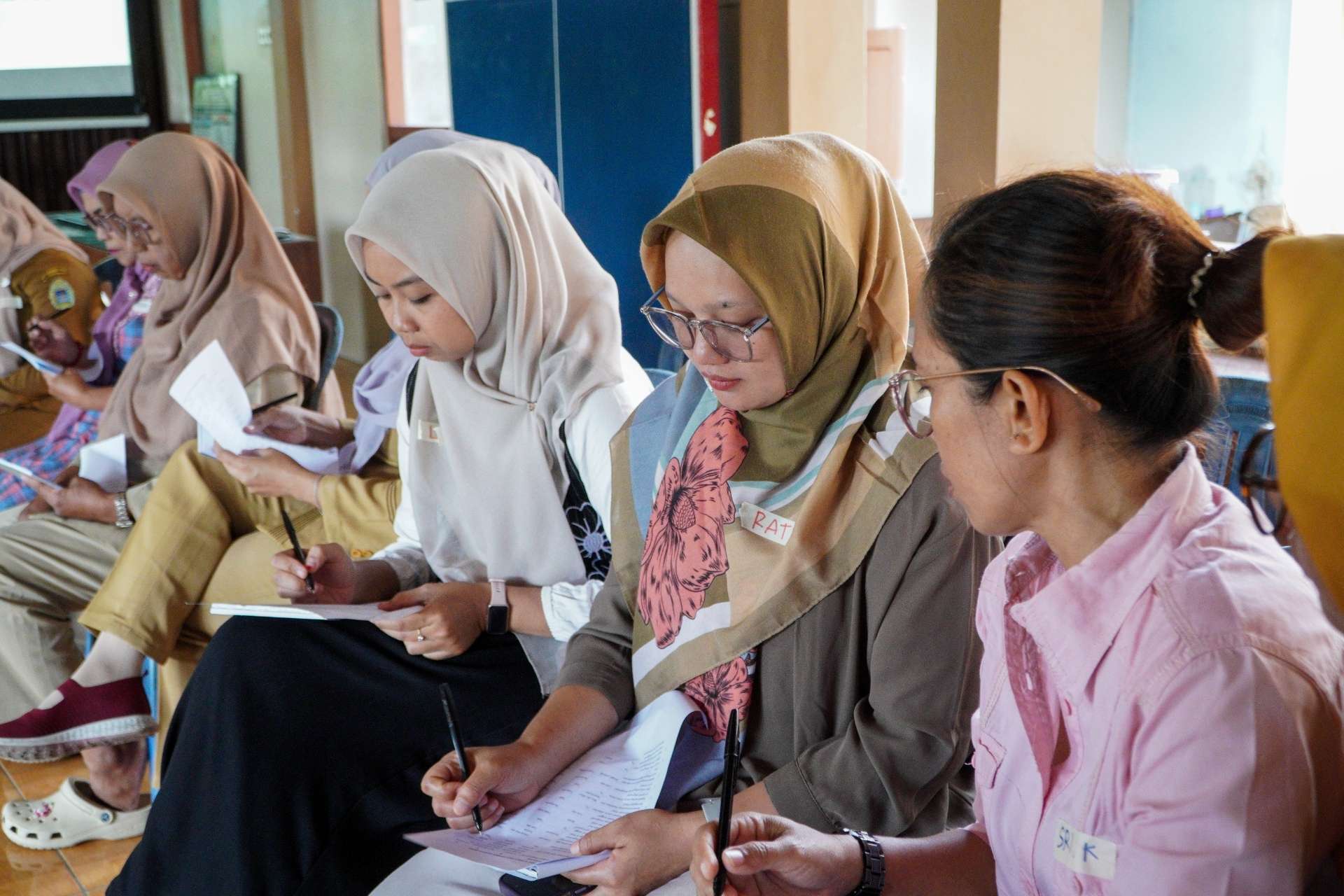
Before the training session began, all participants were asked to complete a pre-test form. This step was conducted to assess their initial understanding of GEDSI issues in water management and inclusive housing, as well as to serve as a baseline for evaluating learning outcomes at the end of the session.

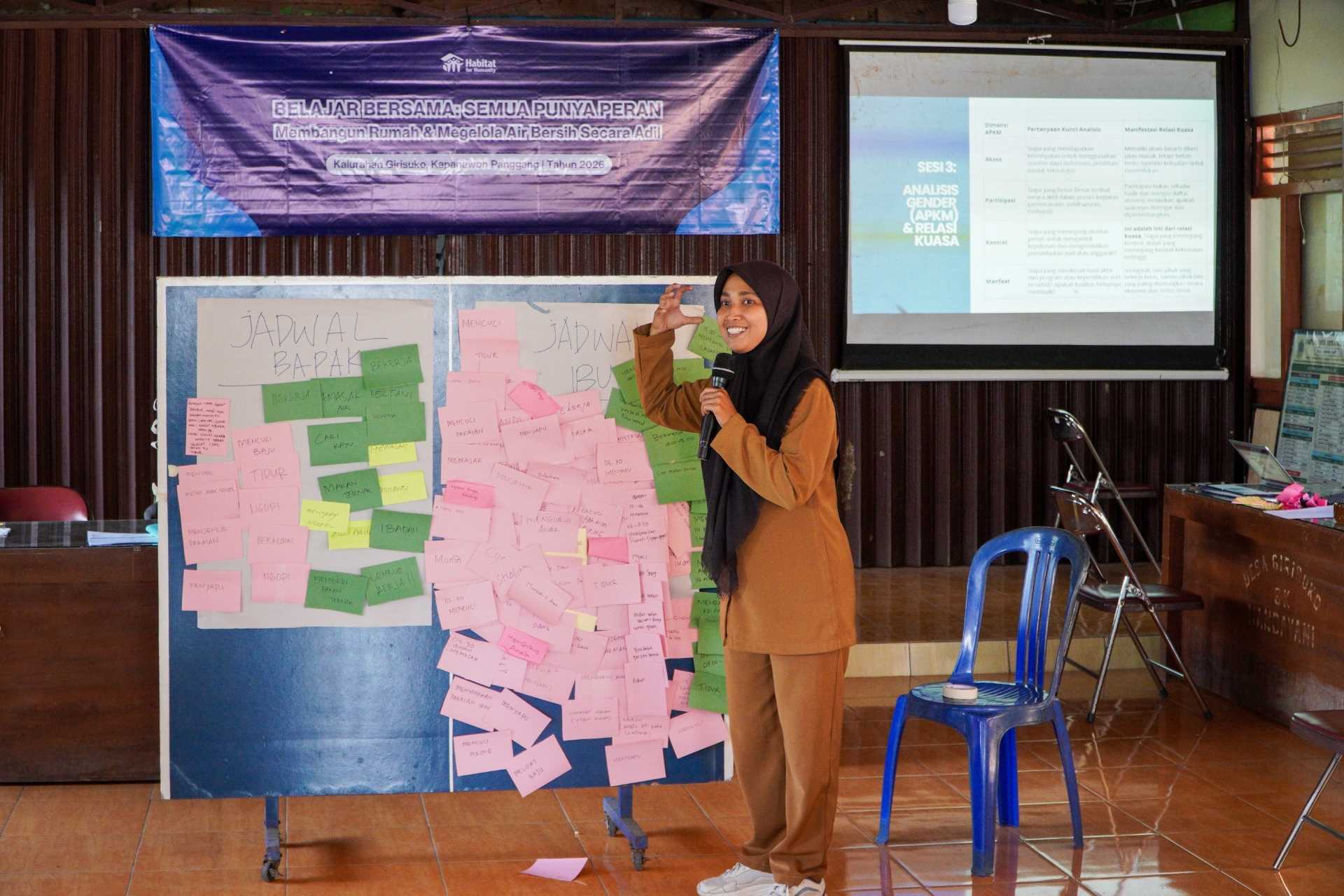
The training session began with an interactive activity where participants were asked to list daily activities and categorize them based on male and female roles. This exercise created space for reflection, highlighting that not all tasks are defined by gender roles, as many activities can be carried out equally by both men and women.

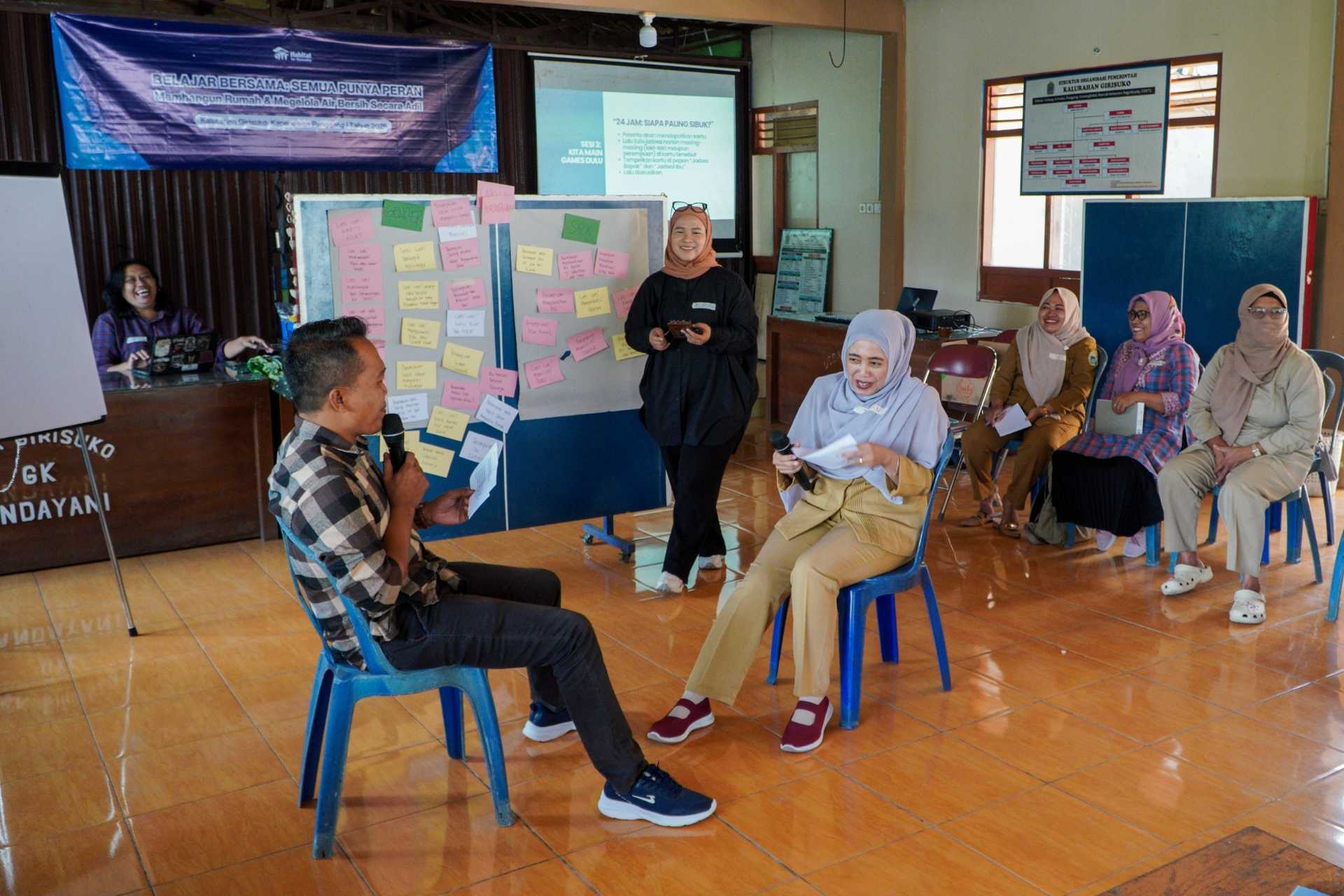
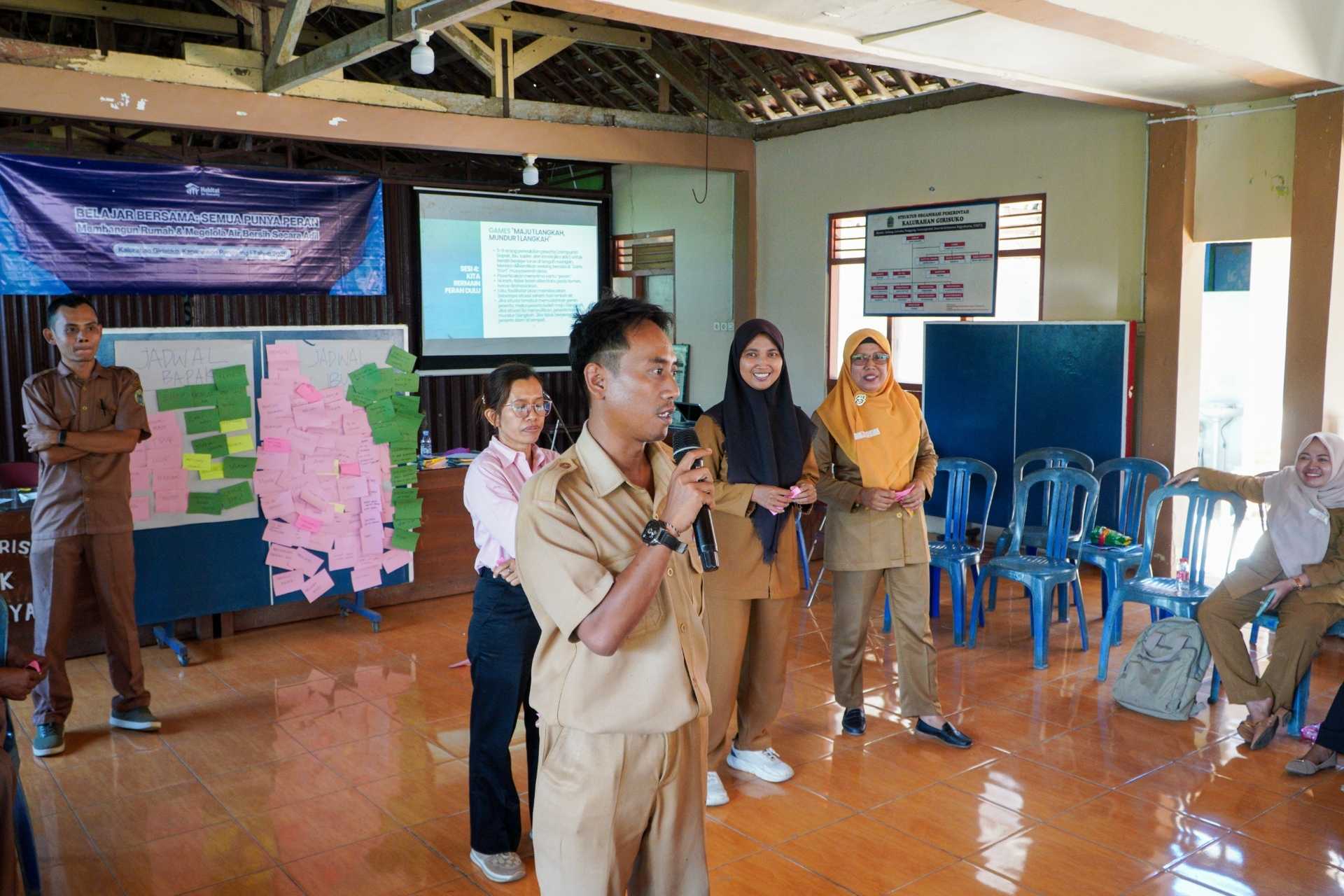
In the middle of the session, Alimah, Gender Officer at Habitat for Humanity Indonesia, invited selected participants to take part in a role-play activity as a father and a mother within a family facing various challenges. This activity helped participants better understand the differences in roles, challenges, and burdens that often arise in everyday family dynamics.

Read also: Photo: Improving Community Health through PHBS Training

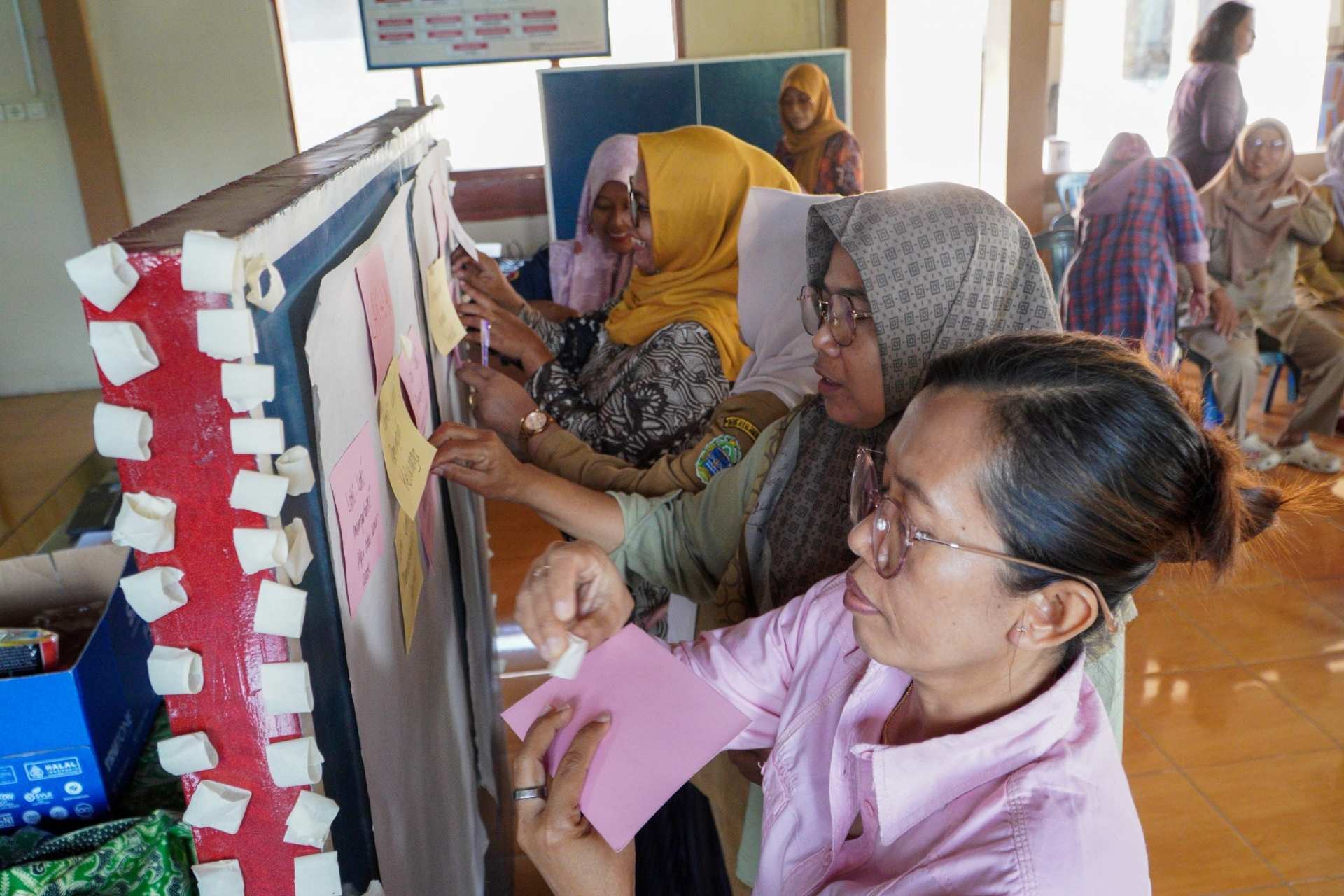
The training, which was divided into four sessions, also organized participants into several groups for Focus Group Discussions (FGD). Through these group discussions, participants were able to exchange perspectives and deepen their understanding of GEDSI issues in water management and inclusive housing at the community level.

One of the female participants, while laughing, shared that in daily life, most household chores are still largely carried out by women rather than men. This simple remark then became a trigger for a deeper discussion on the division of roles within households.

Before the training session concluded, participants took part in the Power Walk game, designed to represent differences in access, opportunities, and social positions in everyday life. Through this activity, participants were able to directly observe how various factors can influence how far a person can progress in life.

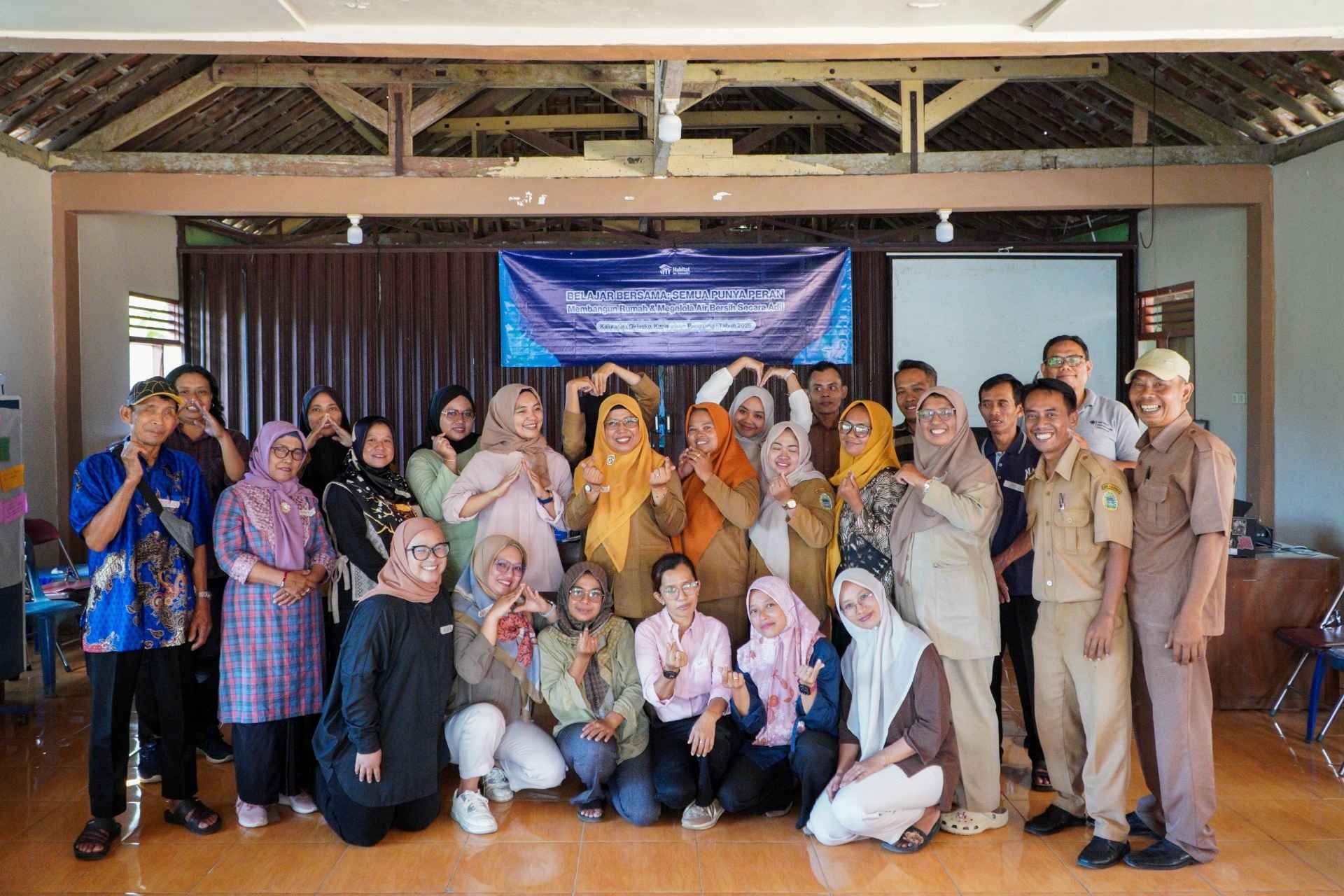
The training session concluded with a group photo of all participants together with the Habitat for Humanity Indonesia team. This moment marked the sense of togetherness after a series of learning activities that not only provided new knowledge but also strengthened understanding of the importance of inclusive water management and housing.

Photo & Writer: Kevin Herbian

(kh/av)

HFHI – Astra
Stories of Change

No Longer Seeking Shelter During the Rain: Andri’s Struggle to Build a Decent Home for His Family

Garut, June 22, 2026 – Andri (36) lives with his wife, Rina (33), and their two children in Garut Regency, West Java. Their first child is currently in the third grade of elementary school, while the youngest is three years old. For the past seven years, this small family has lived in a simple house whose condition was far from decent.

Daily, Andri works on odd jobs with an unpredictable income. When work is available, he becomes a farm laborer or helps forage grass to feed livestock in residents’ gardens. However, his income averages only about IDR 50,000 per day.

With such a limited income, Andri could only afford to repair his house bit by bit. He would sometimes patch the dirt floor with cement whenever he had extra money. “If we are blessed with a little extra income, I use it to patch the floor with cement. But only part of it, I can’t afford to do the whole thing,” Andri said.

Their housing condition was deeply concerning. The roof was made of asbestos without a ceiling, a material that poses health risks, especially for the children who stayed inside every day. Furthermore, the walls were made of woven bamboo that had holes in many places, allowing cold air and rainwater to easily enter the house.

Their biggest fear came whenever the rainy season arrived. “If it’s just light rain, we still brave it out inside the house. But if it’s a heavy downpour accompanied by strong winds, we always evacuate because we are afraid the house might collapse,” Andri explained. “The most difficult part is when it rains at night. It is pitch black here with minimal street lighting. We have to run to my parents’ house to seek shelter,” he recalled.

Andri’s wife, Rina (36), and their daughter stand in front of their uninhabitable home in Garut Regency, Indonesia. Photo: HFHI Team

The hardest period came when Rina was pregnant with their second child. At that time, the family’s economic condition was truly at its lowest point, while the due date was fast approaching. “At that time, I felt hopeless. I felt like I couldn’t be a useful husband and father for my family,” Andri said.

In addition, the fragile condition of the house made them worry about the safety of their unborn baby. After their youngest child was born, Andri and his family finally decided to temporarily evacuate to his parents’ house for two months to avoid any unwanted incidents.

Amid all these struggles, Andri could only keep trying while leaving the rest to God. “I learned to accept reality. I have tried my absolute best to earn a living. The rest, I leave it up to Allah,” he said.

Read also: Seven Years Waiting for a Decent Home: Nining’s Struggle to Care for Her Parents Amid Hardship

New hope finally arrived when Habitat for Humanity Indonesia, in collaboration with Astra, rebuilt Andri’s house into a decent home, along with 84 other families in Garut Regency. “Praise be to God (Alhamdulillah), my life felt filled with a renewed spirit when I found out that my house was selected to be rebuilt,” Andri said emotionally.

For him, this new house is the answer to the long struggle he and his family have endured. “This feels like the fruit of my family’s long struggle to finally have a decent home. I am sure this is the answer to our prayers,” he said.

Now, Andri’s house is much sturdier and safer. Not only was it built with proper walls and roofing, but the house is also equipped with various furniture such as a living room table and chairs, mattresses, wardrobes, and other necessities.

A portrait of Andri’s family standing in front of their now decent home made possible through the support of Astra in Garut Regency, Indonesia. Photo: HFHI/Kevin Herbian

The change has brought a sense of security that they had never truly felt before. “This house makes me feel more confident; it is something I can be proud of. Most importantly, now I am no longer afraid when it rains and I don’t need to stay over at my parents’ house anymore,” Andri said with a smile.

It did not stop there; Habitat Indonesia also invited Andri to get involved in building decent homes for other families in his neighborhood. Armed with his experience as a construction worker, Andri now helps with the house construction after finishing his half-day work in the garden.

This opportunity has also helped increase his income. “Now I have additional income, so it can be twice as much as before,” Andri said.

The transformation is also felt by their children. Andri believes that a safer and more comfortable home environment has significantly improved his children’s physical and mental health. His children are no longer ashamed of their own home.

In this new house, Andri has finally found what he had been searching for all these years: peace of mind. “I am very grateful and would like to thank Astra. This house has truly become a proper place to live. This is what a decent home should be,” Andri concluded.

Andri’s story is proof that a decent home is not just about a sturdy structure, but about providing a sense of security, preserving a family’s dignity, and opening new hope for a better life.

Writer: Kevin Herbian

(kh/av)

HFHI – Sabu
Habitat Updates

Welcoming Hope in Sabu Raijua: Clean Water as a Catalyst for Life

Sabu Raijua, June 17, 2026 – East Nusa Tenggara (NTT) is known for its scenic savanna landscapes. Yet behind this beauty lies a significant challenge: an extreme dry season that lasts up to eight consecutive months each year. In Sabu Raijua Regency, this challenge triggers a daily crisis. Data from BPS NTT 2023 shows that only 46.65% of the population has access to clean drinking water, far below the national average of over 91%.

For Mrs. Libertina Ludji (73), these statistics represent a harsh reality. For decades in Sabu Liae District, this resilient woman has had to walk 500 meters across hilly terrain, carrying jerry cans of water from a communal well that often runs dry during the dry season.

Buying water from tankers at IDR 250,000 for 4,000–5,000 liters becomes a last resort. This cost is extremely burdensome for residents of Sabu Raijua, where the average per capita income (2025) is only IDR 1.56 million per month—just a quarter of the national average. Here, clean water has long been a luxury that undermines community well-being.

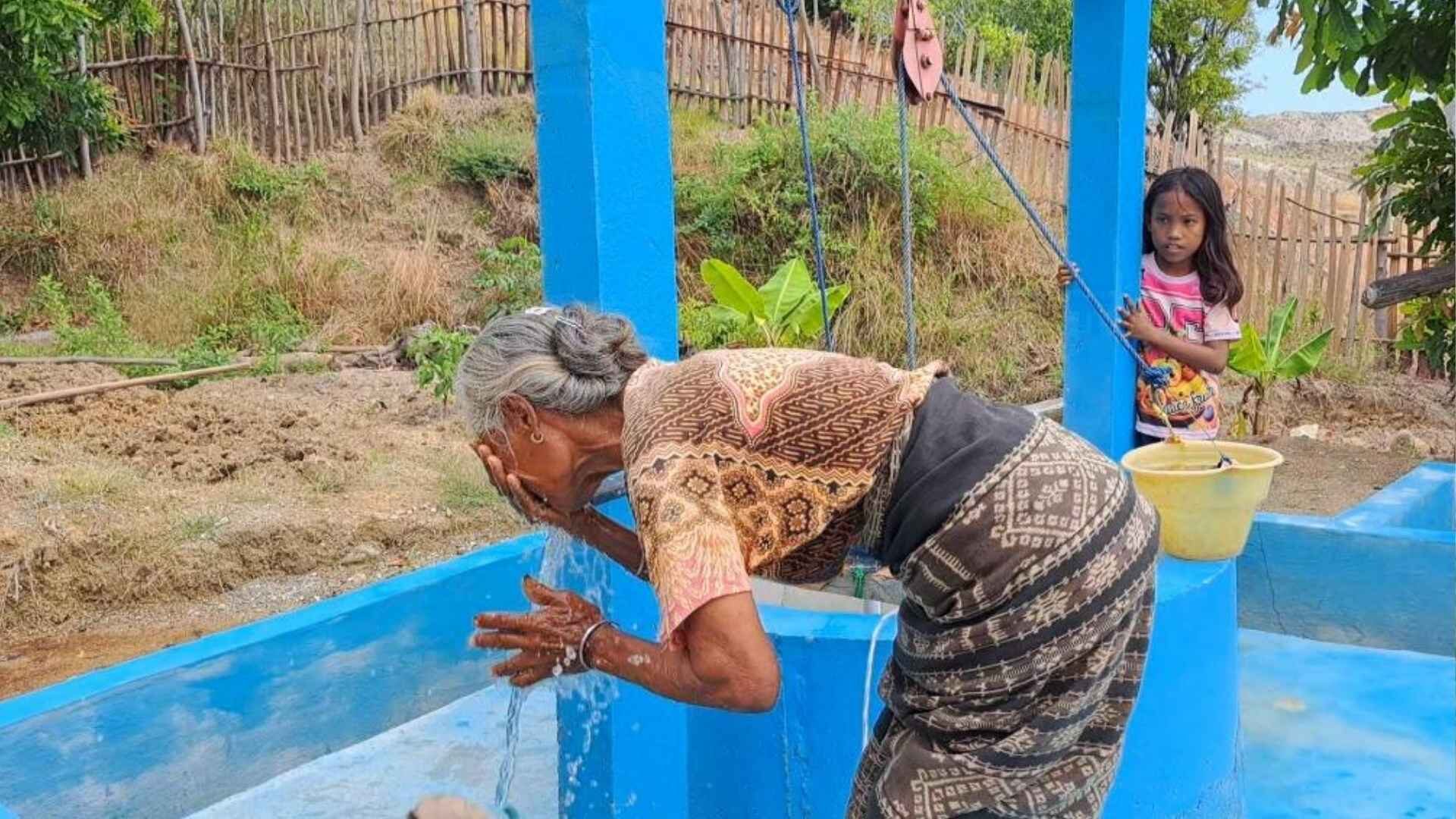
Seeing this situation, Habitat for Humanity Indonesia stepped in to build a communal well prioritized for eight of the most vulnerable families. “We are very happy with this new well. For decades I had to carry water. Now we just turn on the tap, and water flows,” said Mrs. Libertina gratefully.

For Habitat Indonesia, a decent home is not only defined by strong roofs and walls, but also by a healthy supporting ecosystem. Access to clean water brings a domino effect that transforms the long-term future of the Sabu Raijua community. In terms of health, clean water immediately reduces the risk of waterborne diseases such as diarrhea and typhoid, which have long contributed to stunting and child mortality in remote areas.

Read also: Flowing Hope, Building Resilience: Three Years of Habitat for Humanity Indonesia’s Efforts to Improve Access to Water and Sanitation

Beyond that, this intervention fosters sustainable economic independence. The time and energy previously spent queuing for and carrying water can now be redirected toward far more productive activities. Stable access to water opens new opportunities that were previously impossible, such as home gardening, better livestock farming, and even small business initiatives to increase household income.

After experiencing both health and economic benefits, the eight beneficiary families have now taken the initiative to independently plan the construction of a communal water reservoir. They want to ensure that this blessing of clean water does not stop with them, but can also flow to neighboring households.

It is this spirit of community solidarity in Sabu Raijua that brings to life Habitat Indonesia’s vision over its 29 years of work: to create a world where everyone has a decent place to live. Through integrated access to clean water, we remain committed to building homes, communities, and hope—ensuring that every family has an equal opportunity to grow healthier, more independent, and with dignity.

Writer: Astridinar Vania

(av/kh)

HFHI – Songs for NTT (3)
Stories of Change

Opening the Door to Healthier Families in Sabu Island

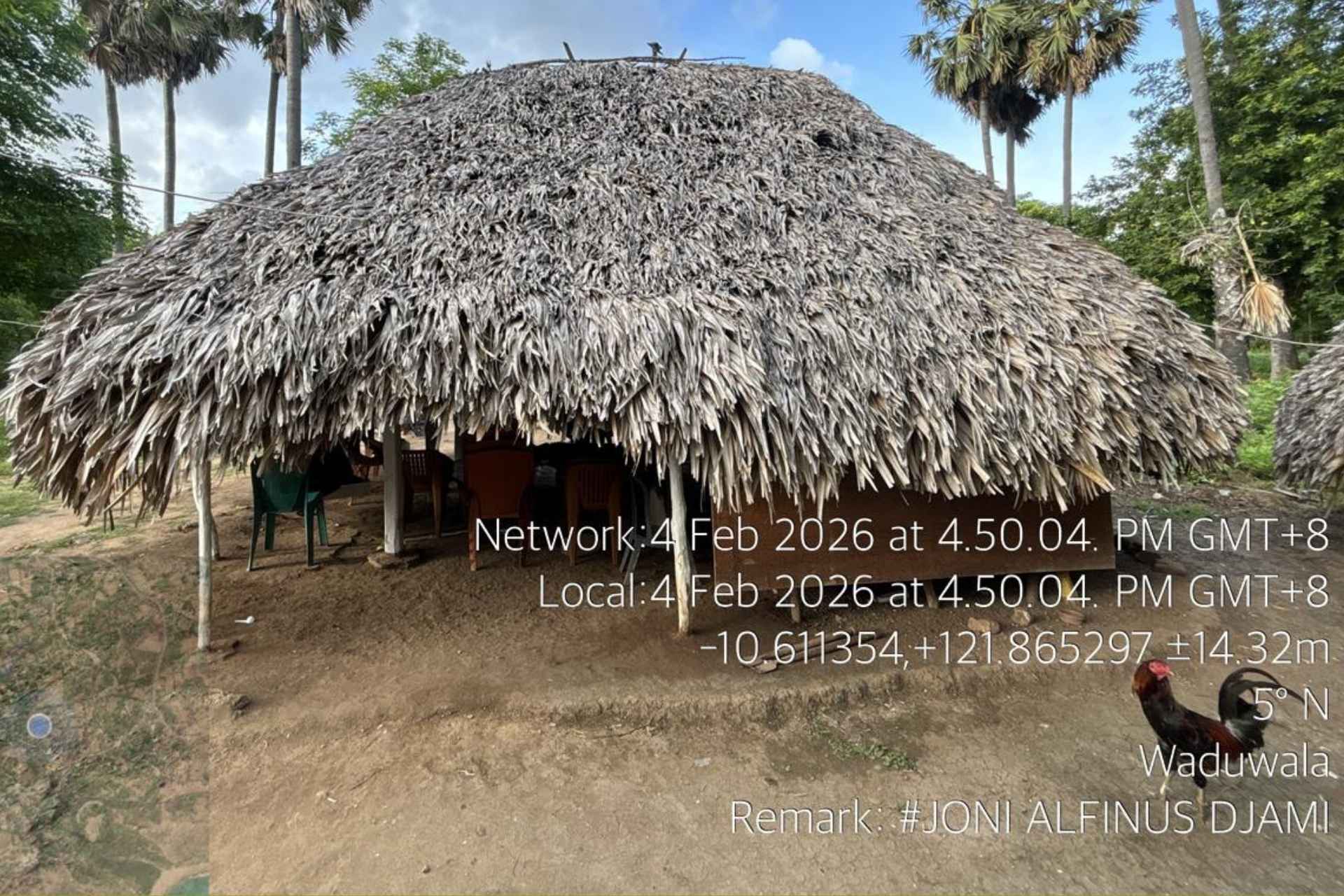
Sabu Raijua, June 12, 2026 – Mornings on Sabu Island often begin with dust. During the dry season, strong winds carry dried leaf fragments from the deteriorating roof of Joni’s house. The floor has to be swept repeatedly every day, yet dust still enters through the gaps in the fragile plywood walls.

A few months ago, Joni’s youngest child, only three months old, fell ill with acute respiratory infection (ARI). Inside the small house, the air felt stuffy due to the lack of windows for proper ventilation. When strong winds blew, dust from the roof continued to fall into the house. “When the wind is strong at night, we are afraid the children will struggle to breathe,” Joni said.

Joni’s story reflects the situation faced by many families on Sabu Island, East Nusa Tenggara. The region recently experienced an extreme drought lasting 128 days without rain, more than twice the national extreme drought threshold according to BMKG in 2025. The prolonged dry season has made communities increasingly vulnerable to health issues and poor housing conditions.

The condition of Joni’s house before it was rebuilt into a decent home in Sabu Raijua, East Nusa Tenggara, Indonesia. Photo: HFHI Team

In East Nusa Tenggara alone, the incidence of acute respiratory infections (ARI) reaches 36.3%. Poorly ventilated houses, deteriorating roofs, and inadequate sanitation are among the factors increasing the risk of respiratory illnesses, especially for children and the elderly.

In Sabu Liae District, where Joni lives, 23,809 families are still living in inadequate housing. Many homes are built with makeshift materials and are unable to provide safe protection from extreme heat, dust, and unpredictable weather conditions.

Amid these challenges, Joni continues his work as a mentor at a local church’s Children Development Center (PPA). With an income of around IDR 1 million (approximately USD 56.58) per month, he and his wife strive to meet the needs of their three children. When most of their income is spent on daily necessities and medical expenses when their children fall sick, improving their home becomes something out of reach.

“The roof often leaked and there was so much dust. But at that time, we didn’t know where to start,” he said.

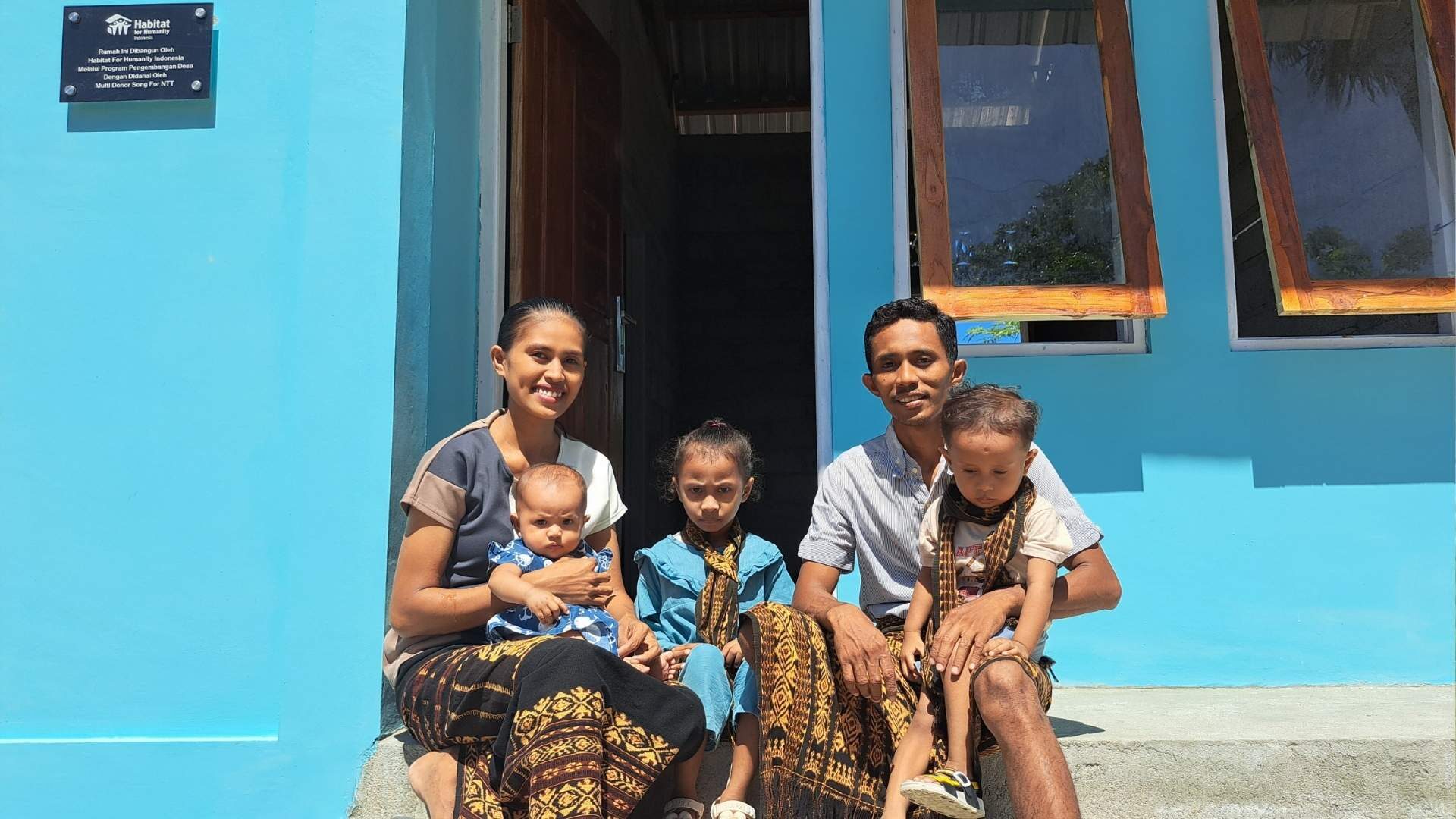
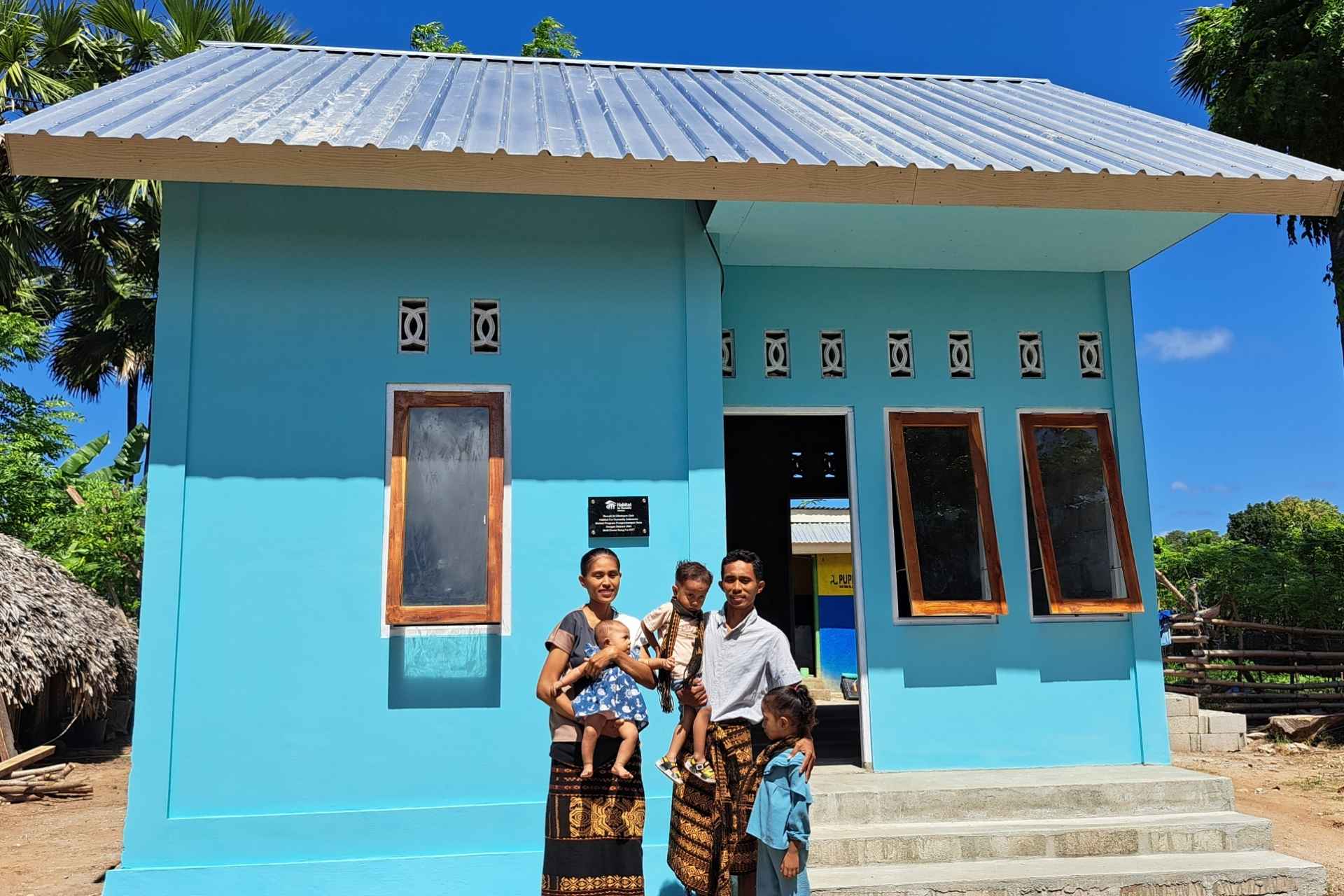
A portrait of Joni’s family in front of their home after it was rebuilt into a decent house in Sabu Raijua, East Nusa Tenggara, Indonesia. Photo: HFHI Team

Read also: Habitat for Humanity Indonesia Arrives in Sabu Raijua, NTT: Efforts to Address Decent Housing Challenges in Eastern Indonesia

When the housing improvement program reached his area, Joni decided to fully participate. He completed the required documents and began collecting river stones on his own for the foundation of his new house. For Joni, the house is not just a new building. It is an opportunity for his children to grow up healthier.

Today, their home has stronger walls, a safer roof, and ventilation that allows better airflow. Dust no longer fills the house every day. “I feel relieved now that the children rarely cough. We also sleep more peacefully,” Joni said.

The change is clearly felt in their daily lives. Money that was previously often spent on medicine is now set aside for the children’s education and nutrition. Joni is also no longer haunted by worry every time the dry season comes or when strong winds blow.

For many families on Sabu Island, a decent home is more than just shelter. A healthy home helps children stay healthy, enables parents to maintain their livelihoods, and gives families the chance to think about their future with greater peace of mind. In regions increasingly vulnerable to extreme weather, a safe home is also the first line of protection for families facing the impacts of climate change.

For Joni, that change began with one simple thing: a home where his children can breathe more easily.

Writer: Astridinar Vania

(av/kh)

HFHI – Astra
Stories of Change

Seven Years Waiting for a Decent Home: Nining’s Struggle to Care for Her Parents Amid Hardship

For years, Nining has lived between exhaustion, worry, and hope that never truly faded. In a fragile house that was nearly collapsing, she cared for her parents who suffered from stroke while trying to survive despite all of life’s limitations.

Garut, June 9, 2026 – Nining (46), a female head of household from Cikajang, Garut Regency, spends most of her days caring for her sick parents. Her father can still walk slowly with the help of a cane, while her mother remains bedridden. At the same time, Nining is also raising her youngest child, who is currently in junior high school.

To meet their daily needs, Nining relies on financial support from her two older children, who are already married and working. The money they send each month must be divided between household expenses and medication for her parents. In fact, she often has to buy food on credit from a neighbor’s small shop just to survive. “Whether it’s enough or not, I just have to make it work,” Nining said softly.

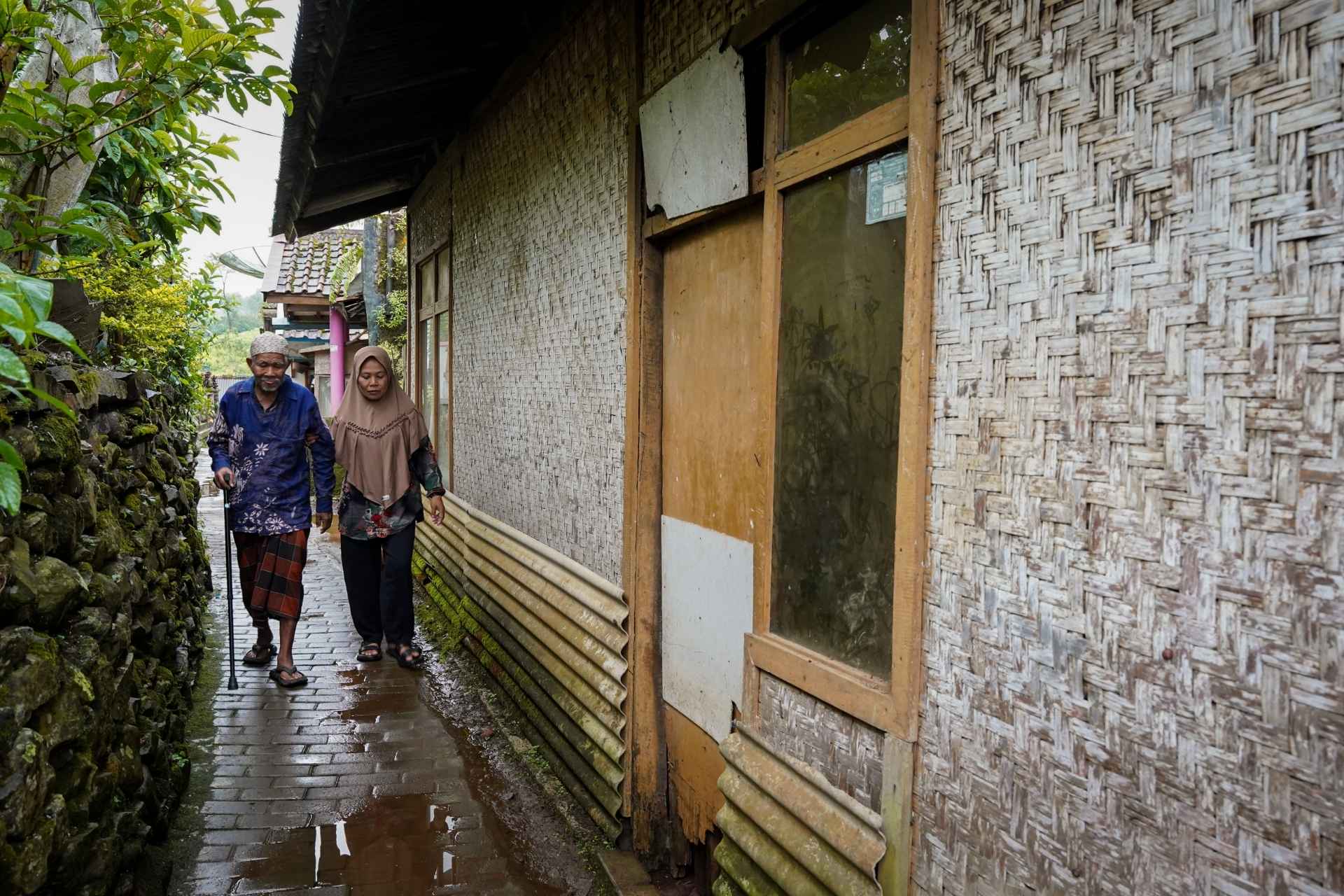
Amid financial hardship, the condition of the house they lived in only made life even more difficult. The house was built from bamboo walls and wooden boards, with a roof made of worn-out roof tiles. Whenever it rained, water leaked into the house from every direction, creating chaos inside.

“My biggest struggle is financial. I only depend on the money my children give me once a month. That money has to cover daily needs and my parents’ medical care. On top of that, we have to live in an uninhabitable house like this. My mind is always overwhelmed,” Nining explained.

Nining guides her parents while walking beside their inadequate home in Garut Regency, Indonesia. Photo: HFHI/Kevin Herbian

To earn additional income, Nining occasionally works as a farm laborer in her neighbor’s fields, earning no more than Rp30,000 per day. Yet even while working, her mind is never truly at peace. “When I’m working in the fields, I’m always thinking about my parents at home because the house is no longer safe to live in,” she said.

Caring for her parents in such a fragile house became a challenge of its own. Whenever heavy rain poured and water started entering the house, Nining had to move her parents to the driest corners of the house to protect them from the leaks.

“One time during heavy rain, the back part of the house collapsed. I panicked and called the neighbors for help because I was afraid it would hit my parents. Thankfully, they weren’t injured because we managed to move them in time,” she recalled.

After the incident, Nining could only afford temporary repairs. She used wooden supports to hold up the structure and covered damaged sections with banners so the house could still be occupied.

Behind all of these struggles, there was one regret that continued to weigh heavily on Nining’s heart. She believes her mother’s condition worsened after falling in their bathroom, which still had dirt flooring and was slippery.

Before meeting Habitat for Humanity Indonesia, Nining had even considered working abroad as a migrant worker. For her, it seemed like the only way to repair the house and afford medical treatment for her parents.

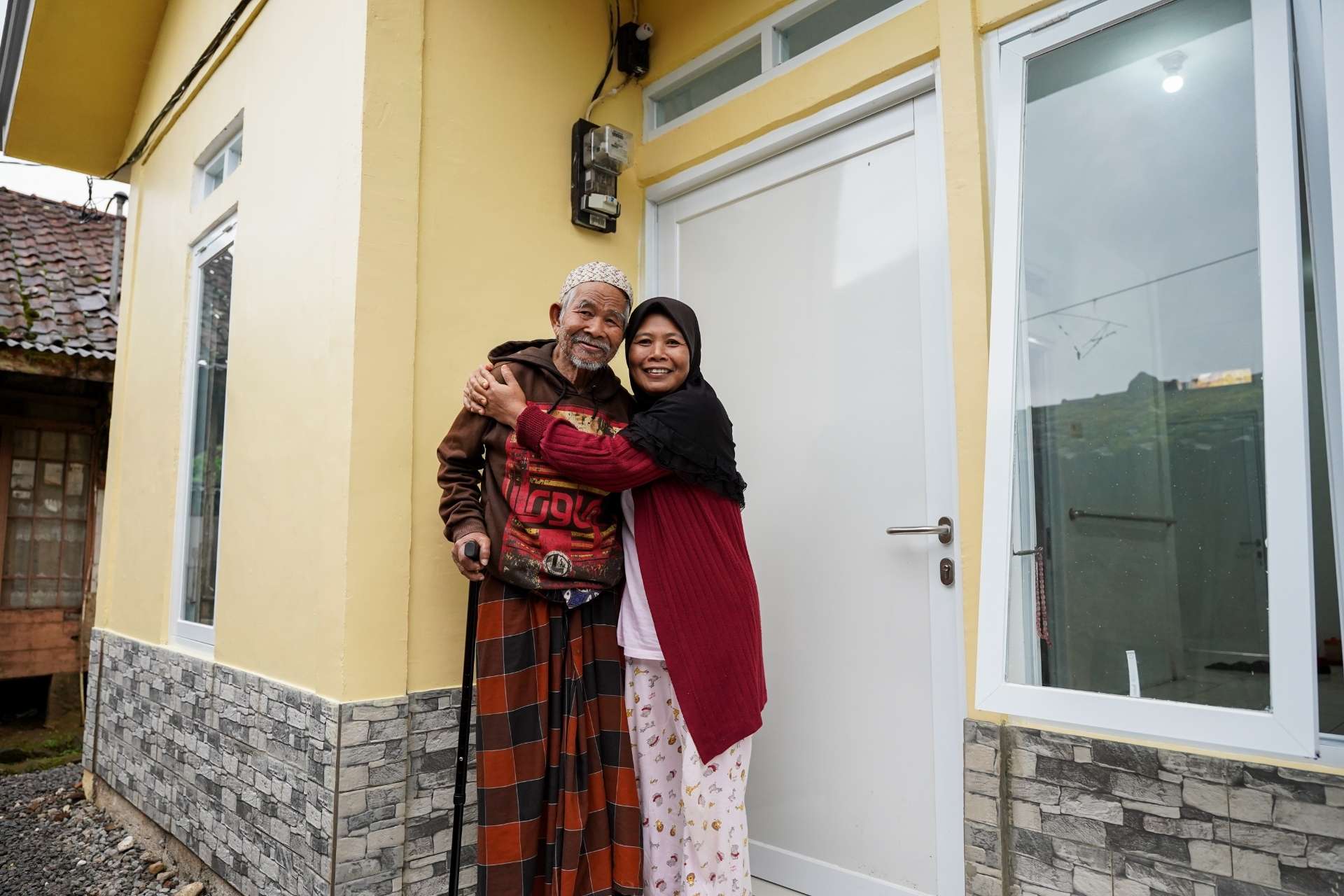
A portrait of Nining and her parents standing in front of their now decent home in Garut Regency, Indonesia. Photo: HFHI/Kevin Herbian

Read also: The Struggle of a Mother Head of Household to Achieve a Decent Home

The hope that once felt so distant finally arrived. With support from Astra, Habitat for Humanity Indonesia rebuilt Nining’s home into a decent and livable house, alongside homes for 84 other families in Garut Regency.

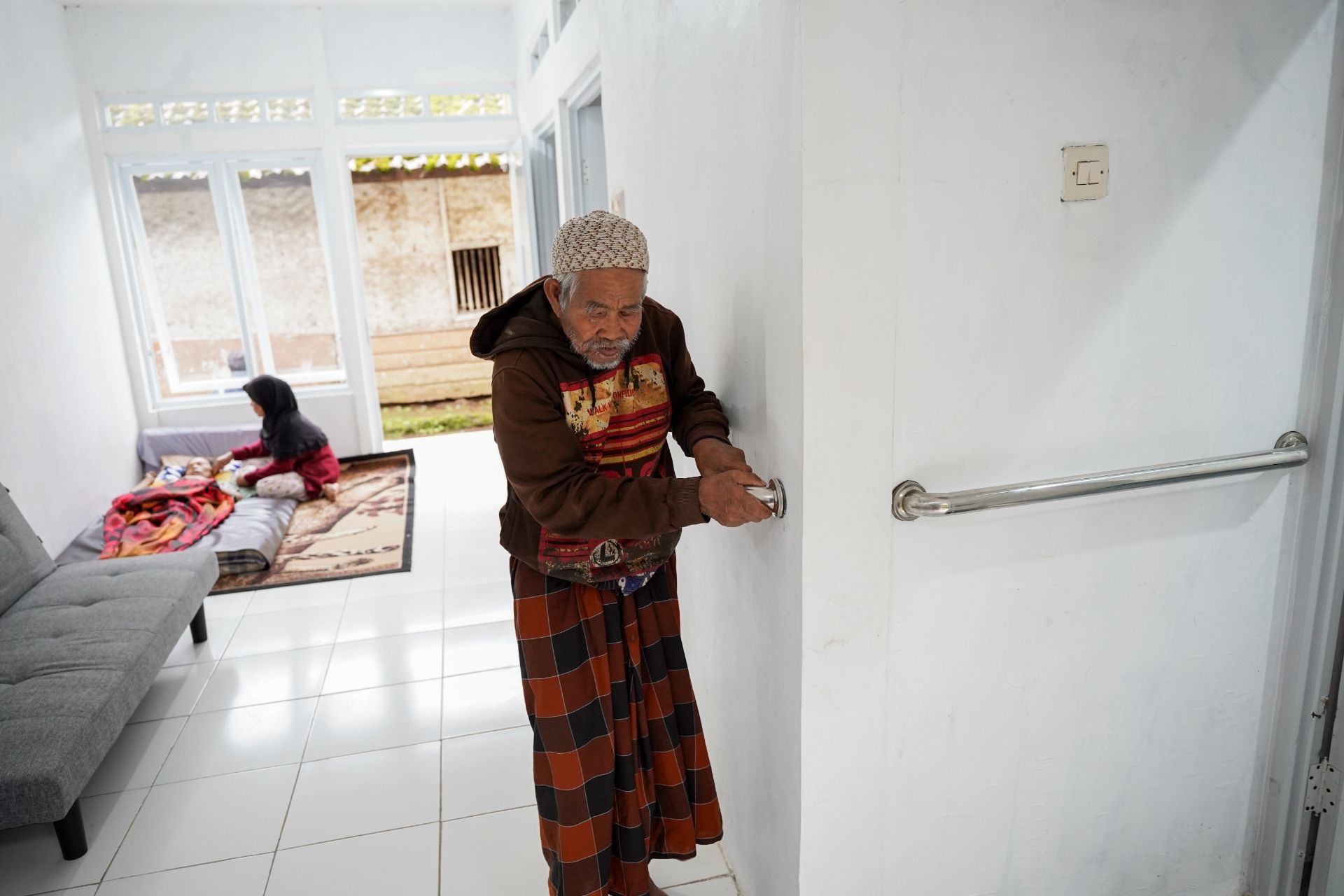
Today, Nining’s house stands strong with bright yellow walls. Not only is it safer and more comfortable, but it was also specially designed to support the needs of elderly people and persons with disabilities. The house is equipped with handrails in the living room and bathroom, as well as wider doorways to make mobility easier for her parents.

In addition, the house is furnished with various household items such as a living room table and chairs, a wardrobe, and beds, making it far more comfortable and suitable for living.

For Nining, this house is the answer to prayers she had been saying for more than seven years. She admitted that she had previously received several promises of assistance, but none had ever materialized until the support finally came through Habitat Indonesia and Astra.

“My house has changed so much. The most important thing is that it never leaks anymore. The house is also much nicer and more pleasant to look at. I no longer feel insecure or embarrassed around my neighbors,” Nining said with tears in her eyes.

Nining’s parents use the handrail installed inside their now decent home in Garut Regency, Indonesia. Photo: HFHI/Kevin Herbian

Having a decent home has also brought new peace into her life. Now, Nining no longer feels overwhelming fear every time she has to leave home to earn additional income. Her home is now equipped with handrails, allowing her elderly father to walk around the house with steady support.

“Because this house is now truly livable, I’m no longer afraid or worried about leaving my parents alone for a while when I go out to work as a farm laborer,” she said.

This house has become a symbol of a daughter’s struggle and devotion to her parents. Despite all the hardships, Nining never stopped trying to provide a safe and decent home where her parents could spend their old age with greater comfort and dignity.

Nining’s story is a reminder that a decent home is not just about walls and a roof, but about safety, peace of mind, and renewed hope for families who have long lived in hardship.

There are still many families like Nining’s who are waiting for the opportunity to have a decent home. Let us be part of the change and help more families build a better life.

Writer: Kevin Herbian

(kh/av)

HFHI – BMZ II
Habitat Updates

Promoting Inclusive Development at the Community Level Through Shared Learning Spaces

Gunungkidul, June 5, 2026 – As part of its commitment to building more resilient and inclusive communities, Habitat for Humanity Indonesia, together with its local partner Sentra Advokasi Perempuan, Disabilitas, dan Anak (SAPDA), continues to strengthen community participation in village development through an approach centered on equality and social inclusion.

Through the Advancing Climate Resilient Communities through Empowering Sustainable Solutions (ACCESS) program, Habitat Indonesia supported the implementation of the Sinau Bareng Warga: Gender Equality, Disability, and Social Inclusion (GEDSI) Mainstreaming activity, held at the Katongan Village Hall, Nglipar District, Gunungkidul Regency, on April 30, 2026. The activity served as a shared learning space for community members to better understand the importance of inclusive development, where every voice—especially women, persons with disabilities, older persons, youth, and other vulnerable groups—has an equal opportunity to be heard.

A total of 15 community representatives from Kepuhsari and Ngrandu hamlets actively participated in discussions facilitated by SAPDA. In an open and participatory atmosphere, participants were encouraged to identify challenges, map available resources, and formulate development ideas that are more responsive to the needs of all members of the community.

Nuryadin Edy Purnama, Project Officer at SAPDA, emphasized the importance of this process as an initial step toward building a more inclusive village. “The purpose of the Sinau Bareng Warga: GEDSI Mainstreaming activity is for us to collectively identify, understand, and comprehensively examine the various challenges and resources within this village, which can later become our foundation for collaborating with the village,” he explained.

Support for this participatory approach was also expressed by the Katongan village government. Wawan, Kamituo representing the Head of Katongan Village, stated that village development must be a collective effort involving all residents without exception. “Everyone has equal rights as community members and can also participate in planning the direction and goals of development, especially here in Katongan Village. Hopefully, our focus will be on how much we can contribute, rather than how much we can gain. If that becomes our shared intention, we will be able to achieve this common goal for shared prosperity,” he said.

A similar perspective was shared by Wasingastu Zakiyah, one of the speakers at the event, who emphasized that inclusive development must ensure that no group is left behind. “Inclusive development processes should involve everyone. No one should be excluded, especially those who have long been marginalized, so they can be equally facilitated in both village planning and development,” she explained.

Through its collaboration with SAPDA under the ACCESS Program, Habitat Indonesia believes that building resilient communities does not only begin with providing access to basic services, but also by creating safe, equal, and inclusive spaces for dialogue. Because when everyone has the same opportunity to participate, development can truly belong to all.

Writer: SAPDA

(kh/av)

HFHI – Pakuwon
Habitat Updates

A Home Once Feared, Now a Place to Return to with Hope

Bogor, May 13, 2026 – A sense of anxiety never truly left Ahmad’s mind. Every night as he left for work, his thoughts remained at home—with his wife and daughter, who had to endure living in a fragile house.

Ahmad (48), a daily factory worker, lives with his small family in Karanggan Village, Gunung Putri District, Bogor Regency. With an unstable income, he can only manage to cover daily necessities. If there is any money left, it goes toward minor home repairs—just enough to prevent severe leaks when it rains.

The house they lived in was far from adequate. Its walls were made of weathered bamboo panels, the roof tiles were fragile, and the structure had weakened over time. “When there’s heavy rain and strong winds, we’re afraid the house might collapse,” Ahmad said.

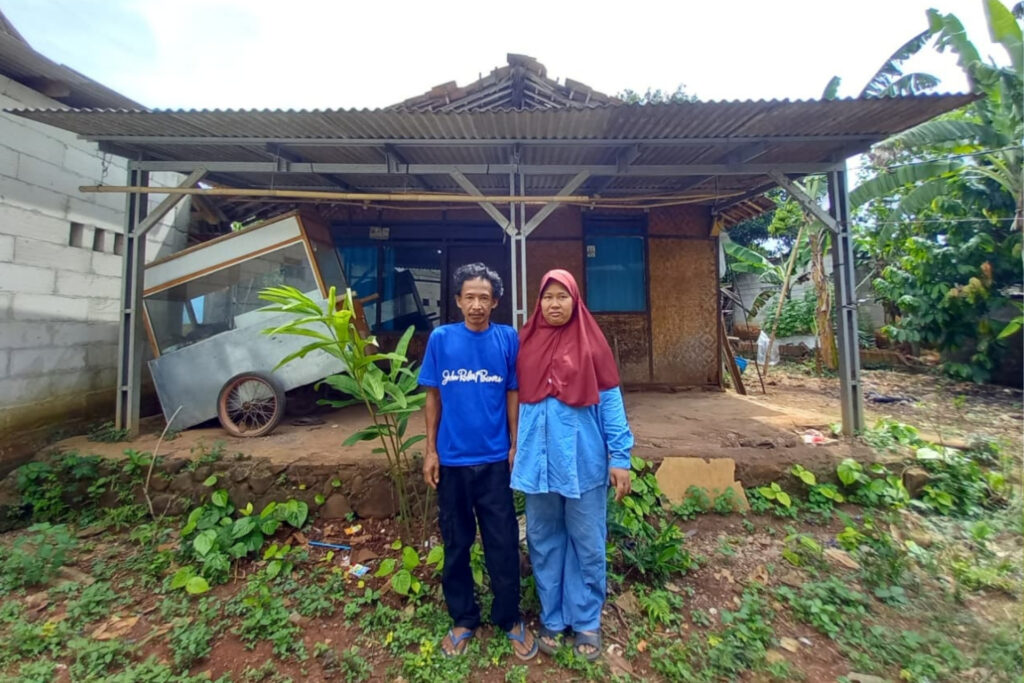
A portrait of Ahmad and his wife standing in front of their home before it was rebuilt into a decent house by Habitat for Humanity Indonesia in partnership with Pakuwon Peduli in Bogor Regency, Indonesia. Photo: HFHI/Ari Darmawan

This worry grew even stronger because Ahmad often works night shifts. “Every time I go to work, I worry about my wife and child at home. It’s always on my mind—I can’t feel at ease, I’m afraid something might happen to the house,” he explained.

But it wasn’t only about safety that weighed on him. As a father, his heart felt even heavier when he learned that his daughter felt embarrassed about their home.

“My daughter told me that when her friends want to come over, she always says, ‘not at my house.’ Maybe she understands the condition of our home—that it’s not nice,” Ahmad shared. “As a parent, I understand. She must feel embarrassed because her home isn’t like others.”

Read also: Habitat for Humanity Indonesia and Pakuwon Group Continue Collaboration to Build Decent Housing in Gresik

Seeing this situation, Habitat for Humanity Indonesia, with support from Pakuwon Peduli, stepped in to bring new hope. Through a housing program, Ahmad’s home was rebuilt along with 19 other families in Karanggan Village. In addition, support was provided to 20 families through the construction of household toilets, as well as the improvement of five public facilities in the area.

“I would like to express my deepest gratitude to Pakuwon for helping my family. This support means so much to us,” Ahmad said gratefully.

Now, Ahmad’s house stands strong, with neatly painted blue walls, a sturdy roof, and a much safer structure. This transformation is not only visible physically but is also deeply felt in their daily lives.

Ahmad admits that the new house has changed many things. He is no longer haunted by worry every time he leaves for work. There are no more concerns about leaks or the risk of collapse. The burden he once carried has gradually lifted.

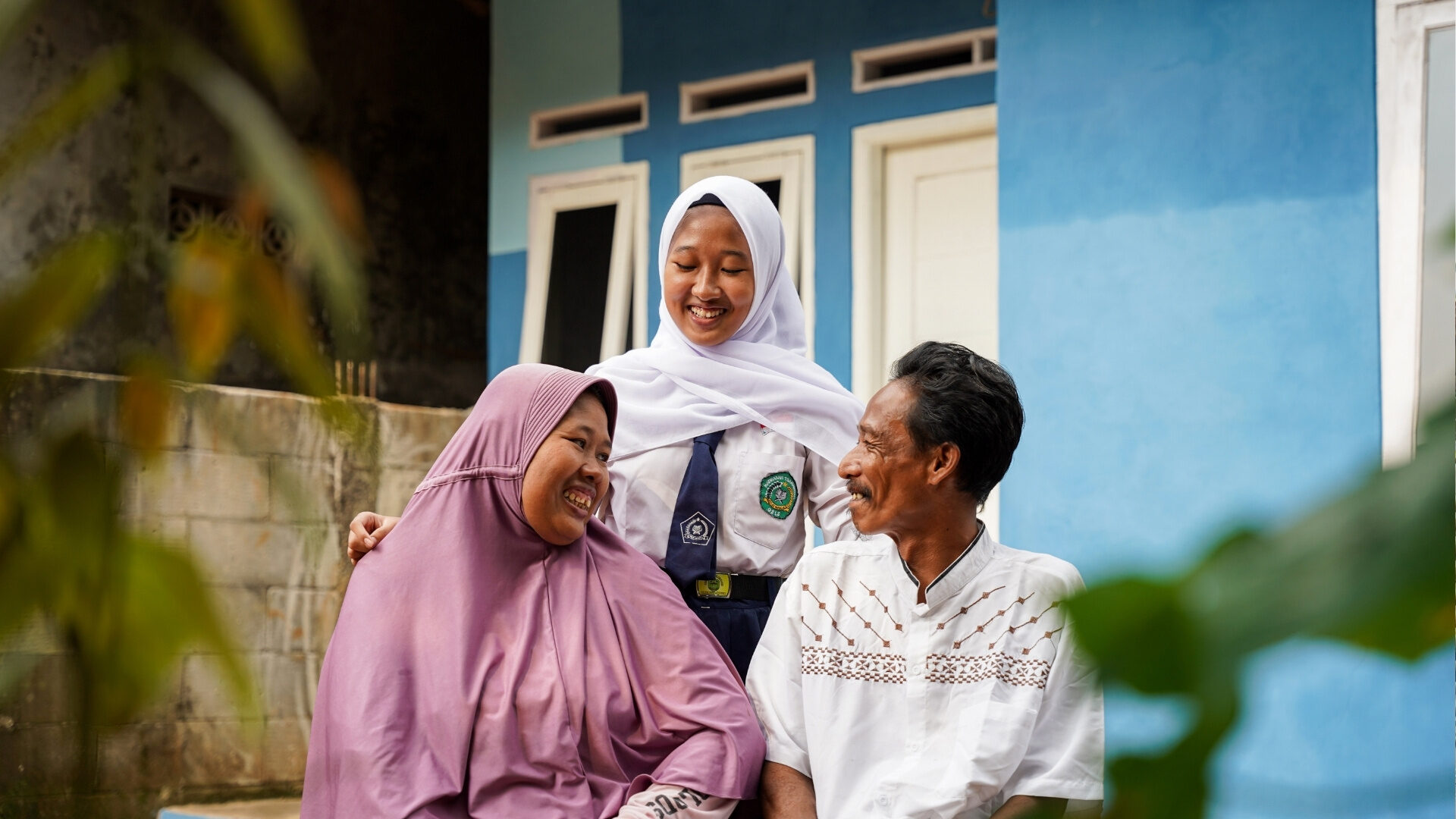
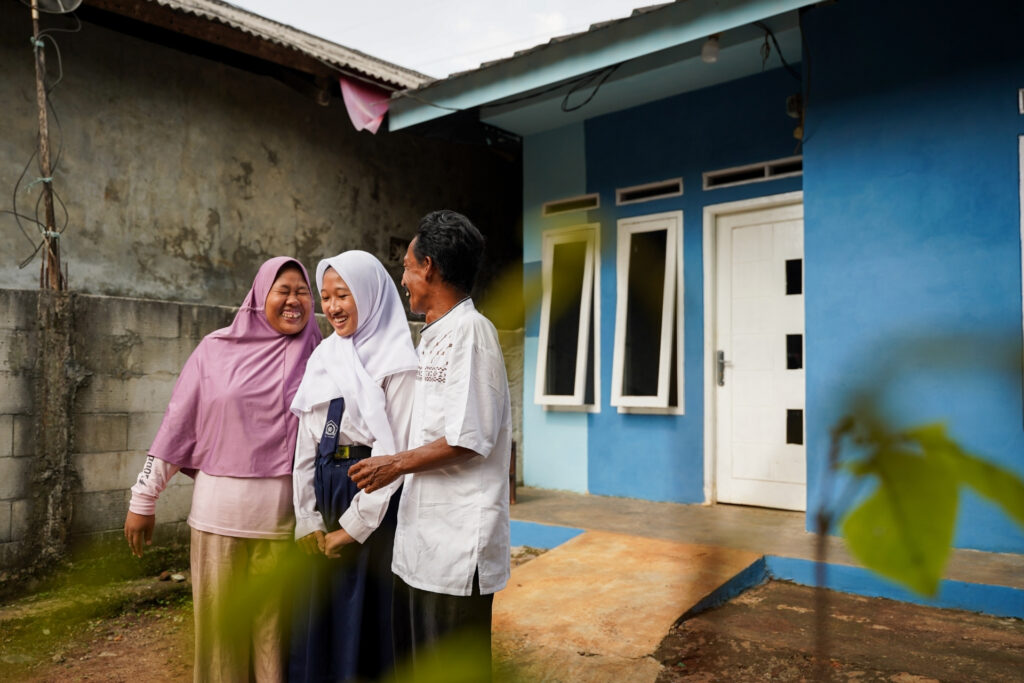
A portrait of Ahmad’s family’s happiness in front of their now decent home after it was rebuilt by Habitat for Humanity Indonesia in partnership with Pakuwon Peduli in Bogor Regency, Indonesia. Photo: HFHI/Kevin Herbian

More than that, the house has restored the family’s confidence and dignity. His daughter no longer feels ashamed. She now feels comfortable inviting her friends over to study together—something that once felt impossible.

The most tangible change soon followed. After several months of living in the new home, his daughter showed improved academic performance. From previously ranking third in her class, she has now risen to second place.

Ahmad’s story is proof that a decent home is not merely a place to live, but a vital foundation that affects many aspects of life—from safety and health to confidence and a child’s future.

There are still many families like Ahmad’s who are waiting for the opportunity to experience similar change. Let’s be part of this transformation and help more families gain access to safe and decent housing for a better life.

Writer: Kevin Herbian

(kh/av)