Seven Years Waiting for a Decent Home: Nining’s Struggle to Care for Her Parents Amid Hardship
For years, Nining has lived between exhaustion, worry, and hope that never truly faded. In a fragile house that was nearly collapsing, she cared for her parents who suffered from stroke while trying to survive despite all of life’s limitations.
Garut, June 9, 2026 – Nining (46), a female head of household from Cikajang, Garut Regency, spends most of her days caring for her sick parents. Her father can still walk slowly with the help of a cane, while her mother remains bedridden. At the same time, Nining is also raising her youngest child, who is currently in junior high school.
To meet their daily needs, Nining relies on financial support from her two older children, who are already married and working. The money they send each month must be divided between household expenses and medication for her parents. In fact, she often has to buy food on credit from a neighbor’s small shop just to survive. “Whether it’s enough or not, I just have to make it work,” Nining said softly.
Amid financial hardship, the condition of the house they lived in only made life even more difficult. The house was built from bamboo walls and wooden boards, with a roof made of worn-out roof tiles. Whenever it rained, water leaked into the house from every direction, creating chaos inside.
“My biggest struggle is financial. I only depend on the money my children give me once a month. That money has to cover daily needs and my parents’ medical care. On top of that, we have to live in an uninhabitable house like this. My mind is always overwhelmed,” Nining explained.
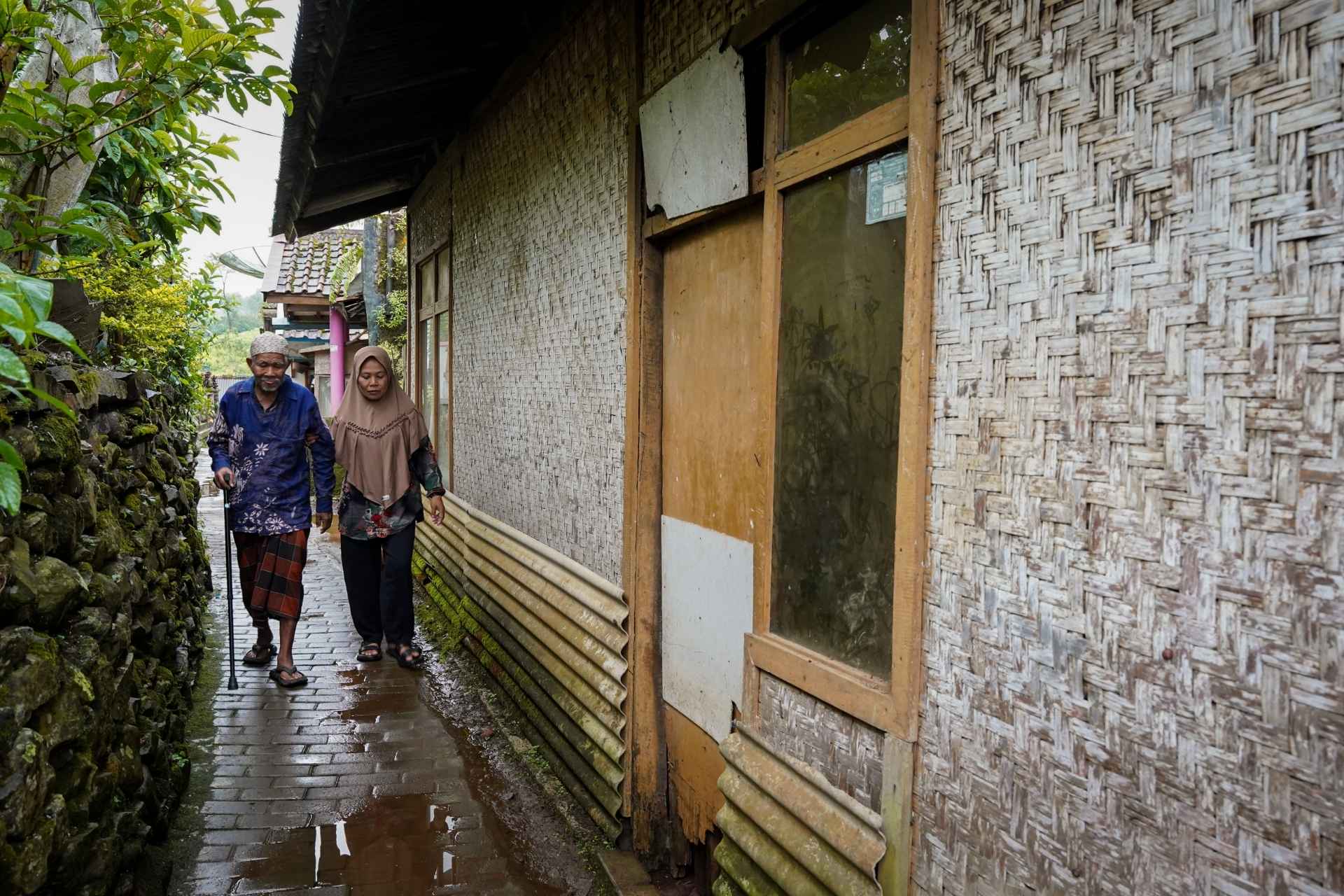
Nining guides her parents while walking beside their inadequate home in Garut Regency, Indonesia. Photo: HFHI/Kevin Herbian
To earn additional income, Nining occasionally works as a farm laborer in her neighbor’s fields, earning no more than Rp30,000 per day. Yet even while working, her mind is never truly at peace. “When I’m working in the fields, I’m always thinking about my parents at home because the house is no longer safe to live in,” she said.
Caring for her parents in such a fragile house became a challenge of its own. Whenever heavy rain poured and water started entering the house, Nining had to move her parents to the driest corners of the house to protect them from the leaks.
“One time during heavy rain, the back part of the house collapsed. I panicked and called the neighbors for help because I was afraid it would hit my parents. Thankfully, they weren’t injured because we managed to move them in time,” she recalled.
After the incident, Nining could only afford temporary repairs. She used wooden supports to hold up the structure and covered damaged sections with banners so the house could still be occupied.
Behind all of these struggles, there was one regret that continued to weigh heavily on Nining’s heart. She believes her mother’s condition worsened after falling in their bathroom, which still had dirt flooring and was slippery.
Before meeting Habitat for Humanity Indonesia, Nining had even considered working abroad as a migrant worker. For her, it seemed like the only way to repair the house and afford medical treatment for her parents.
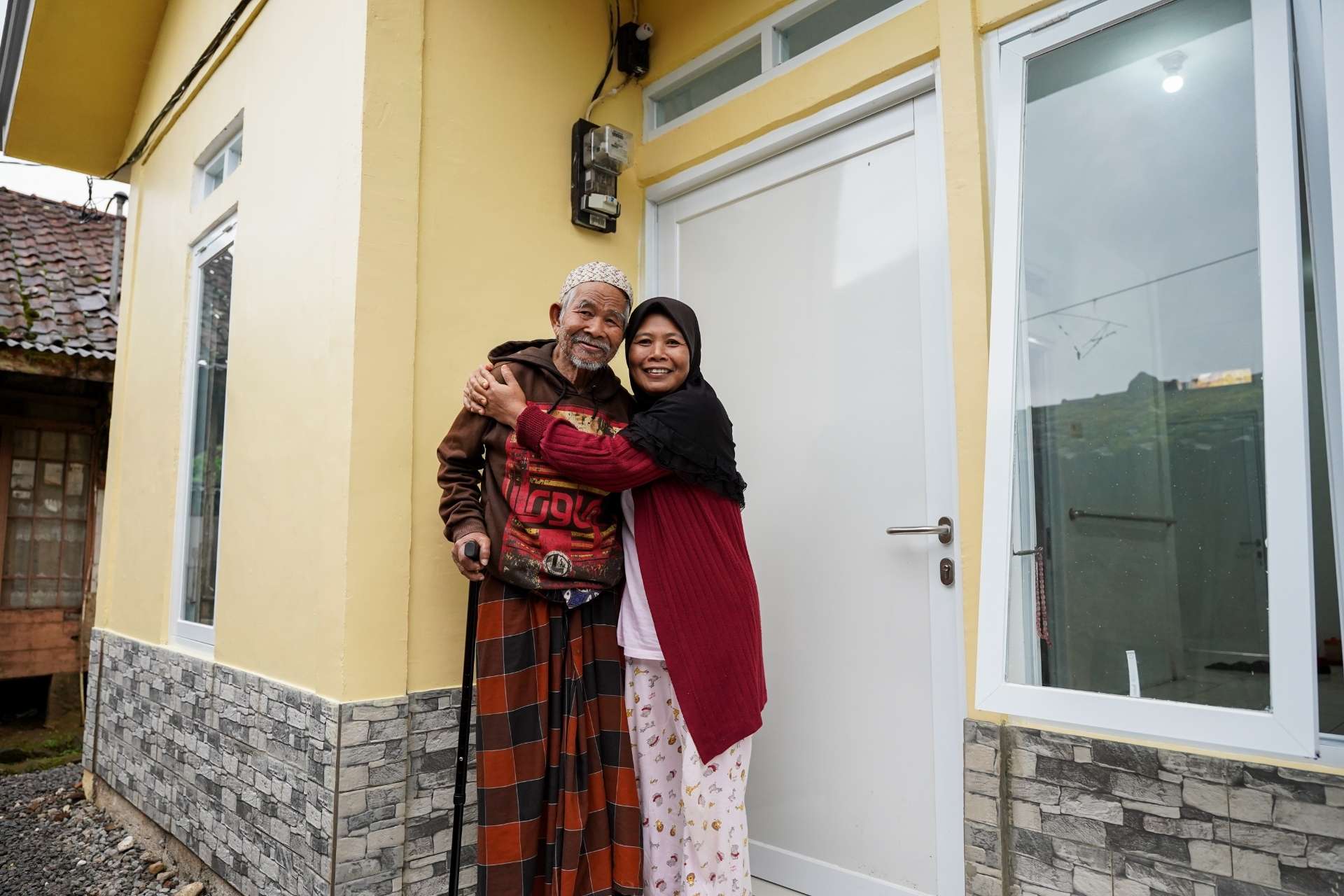
A portrait of Nining and her parents standing in front of their now decent home in Garut Regency, Indonesia. Photo: HFHI/Kevin Herbian
Read also: The Struggle of a Mother Head of Household to Achieve a Decent Home
The hope that once felt so distant finally arrived. With support from Astra, Habitat for Humanity Indonesia rebuilt Nining’s home into a decent and livable house, alongside homes for 84 other families in Garut Regency.
Today, Nining’s house stands strong with bright yellow walls. Not only is it safer and more comfortable, but it was also specially designed to support the needs of elderly people and persons with disabilities. The house is equipped with handrails in the living room and bathroom, as well as wider doorways to make mobility easier for her parents.
In addition, the house is furnished with various household items such as a living room table and chairs, a wardrobe, and beds, making it far more comfortable and suitable for living.
For Nining, this house is the answer to prayers she had been saying for more than seven years. She admitted that she had previously received several promises of assistance, but none had ever materialized until the support finally came through Habitat Indonesia and Astra.
“My house has changed so much. The most important thing is that it never leaks anymore. The house is also much nicer and more pleasant to look at. I no longer feel insecure or embarrassed around my neighbors,” Nining said with tears in her eyes.
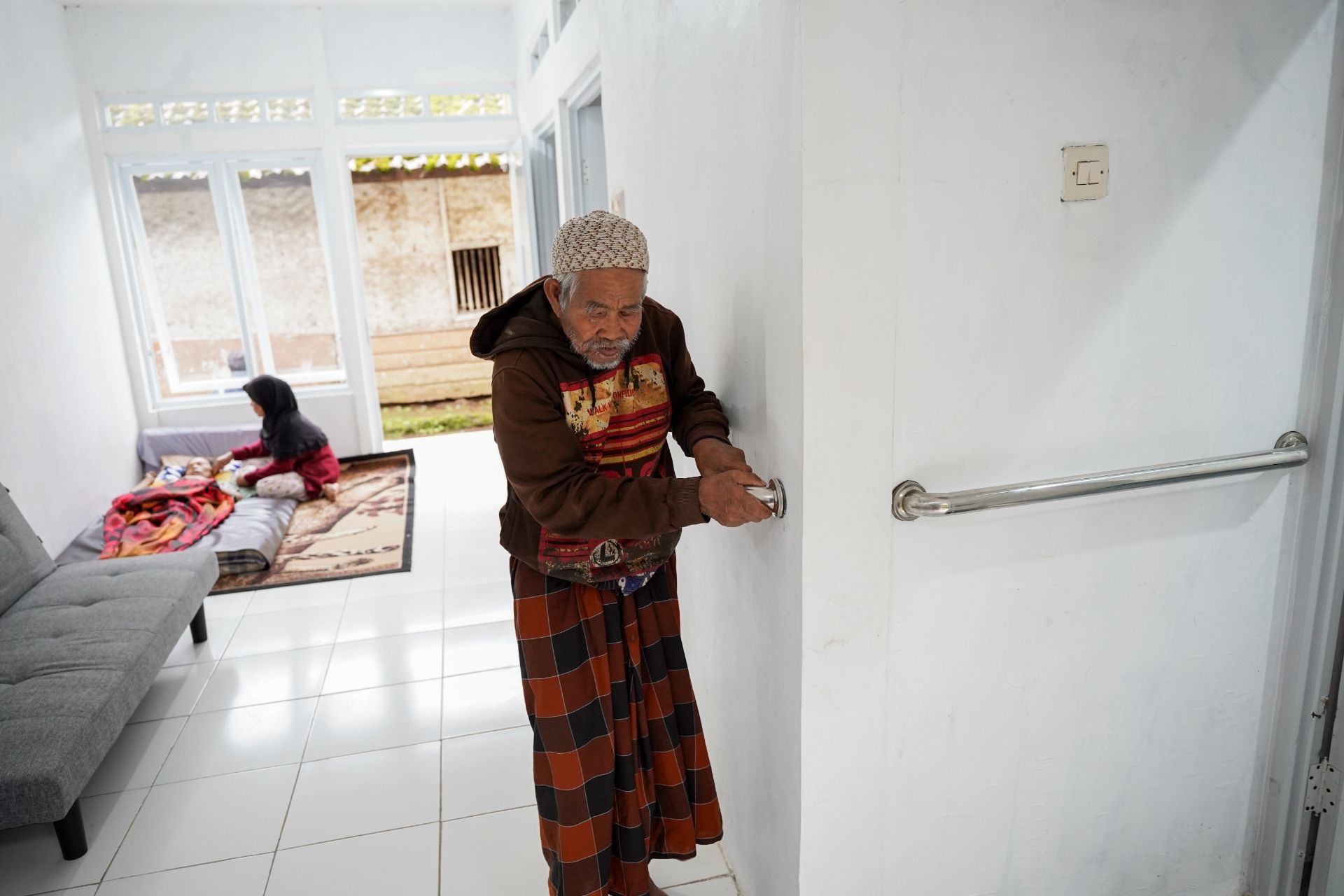
Nining’s parents use the handrail installed inside their now decent home in Garut Regency, Indonesia. Photo: HFHI/Kevin Herbian
Having a decent home has also brought new peace into her life. Now, Nining no longer feels overwhelming fear every time she has to leave home to earn additional income. Her home is now equipped with handrails, allowing her elderly father to walk around the house with steady support.
“Because this house is now truly livable, I’m no longer afraid or worried about leaving my parents alone for a while when I go out to work as a farm laborer,” she said.
This house has become a symbol of a daughter’s struggle and devotion to her parents. Despite all the hardships, Nining never stopped trying to provide a safe and decent home where her parents could spend their old age with greater comfort and dignity.
Nining’s story is a reminder that a decent home is not just about walls and a roof, but about safety, peace of mind, and renewed hope for families who have long lived in hardship.
There are still many families like Nining’s who are waiting for the opportunity to have a decent home. Let us be part of the change and help more families build a better life.
Writer: Kevin Herbian
(kh/av)