Stories of Change
Karawang, September 21, 2026 – That morning, Nenih, a resident of Baturaden Village, Batujaya Subdistrict, Karawang Regency, was overcome with a mixture of emotion, sadness, and happiness. After 61 years of life, she was finally able to experience clean water flowing directly into her home for the first time. For some people, water may be an ordinary part of everyday life. For Nenih, however, it was something she had long been able to do nothing more than hope for.
Throughout her life, Nenih had relied on an irrigation canal located about 100 meters from her home. The water served as her primary source for various daily needs, from bathing and washing clothes to washing rice and other food ingredients. Yet the water was far from suitable for use. It was often cloudy, foul-smelling, and contaminated with dirt.
Nenih was not the only one. Several families living nearby also depended on the irrigation canal for their daily water needs. For families with better financial means, digging a well was an option. However, this was not an easy choice for Nenih, who had to make ends meet on a limited income.
Nenih is a widow who works as a farm laborer, earning no more than IDR 100,000 a day. At home, she also takes care of and raises her grandchildren because their parents work as Indonesian migrant workers overseas. With her limited income and the many family needs she has to meet, providing a water source of her own was something she could not yet afford.
For drinking water, Nenih had to purchase refillable drinking water. Each gallon cost around IDR 5,000, and she could use up to 30 gallons a month, spending approximately IDR 150,000 just to obtain water that was safe to drink.
“If one gallon costs IDR 5,000, I can use up to 30 gallons a month. So, that’s around IDR 150,000 just for drinking water. Whether it is enough or not, I still have to make it work. What else can I do? We need water, but I also have to divide the money between food and school expenses,” Nenih said.
The situation became even more difficult during the dry season. The flow of the irrigation water that the family depended on decreased significantly, sometimes leaving behind only very murky water. During such times, Nenih had to wait until morning, when the water conditions were slightly better, before collecting it and carrying it home.
“During the dry season, there is less water and it becomes more polluted. The only solution is to save water. Usually, every morning I check the condition of the water first. If it looks a little better, I collect it and carry it home,” she said.
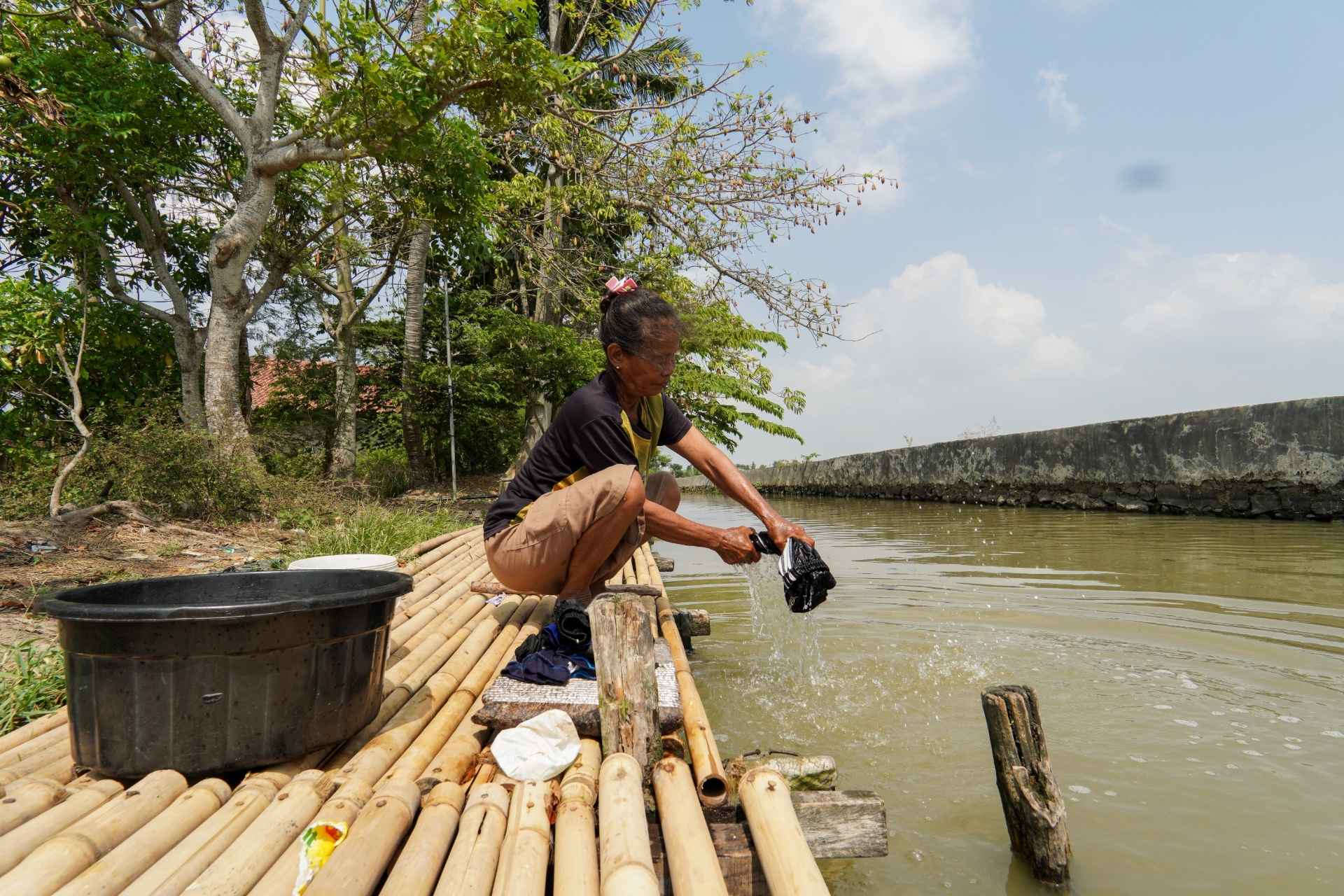
Nenih used to rely on irrigation water to wash clothes, vegetables, and food ingredients, and even to bathe, before receiving clean water assistance from Habitat for Humanity in Baturaden Village, Karawang Regency. Photo: HFHI/Kevin Herbian
A distance of 100 meters between her home and the water source may not sound particularly far. For Nenih, however, the journey was not easy. She has impaired vision in her left eye following a workplace accident. This condition made collecting and carrying water even more exhausting, especially when she had to make repeated trips to meet her family’s daily needs.
Using water from the irrigation canal was also a source of concern for Nenih. She recalled that her grandchildren had experienced itchy skin several times after using the water. The cloudy, contaminated water meant that even simple activities such as bathing and washing had to be carried out under difficult conditions.
Nenih’s experience shows that access to clean water is about more than simply having water available for drinking. Safe and adequate water is an essential part of a decent home because it is directly connected to health, hygiene, comfort, and a family’s ability to carry out daily activities safely and with dignity.
Then, a glimmer of hope finally arrived. Change began when Habitat for Humanity Indonesia, together with Habitat for Humanity Netherlands, developed a clean water supply system using water from the local irrigation canal. The system is equipped with filtration technology to treat the water before distributing it to 10 priority families who previously lacked adequate access to clean water.
To ensure the quality of the water, the filtered water was also tested in a laboratory. This step was taken to ensure that the water met the required quality standards before being used by the beneficiary families.
Today, the water that Nenih once had to collect and carry approximately 100 meters from the irrigation canal is now available much closer to her home. “I no longer use water from the canal. Now I use the new water for everything—from bathing and using the toilet to washing clothes and vegetables,” Nenih said.
The change may seem simple, but it has had a profound meaning for Nenih. She no longer has to wait for the irrigation water to improve, carry water home, or worry when the dry season makes the water source increasingly difficult to use.
What she notices most is the difference it has made for her grandchildren. “My grandchildren are also very happy because they can bathe using clean water. They no longer complain about having to bathe with muddy water mixed with dirt. I am happy to see them being able to bathe more comfortably,” Nenih said.
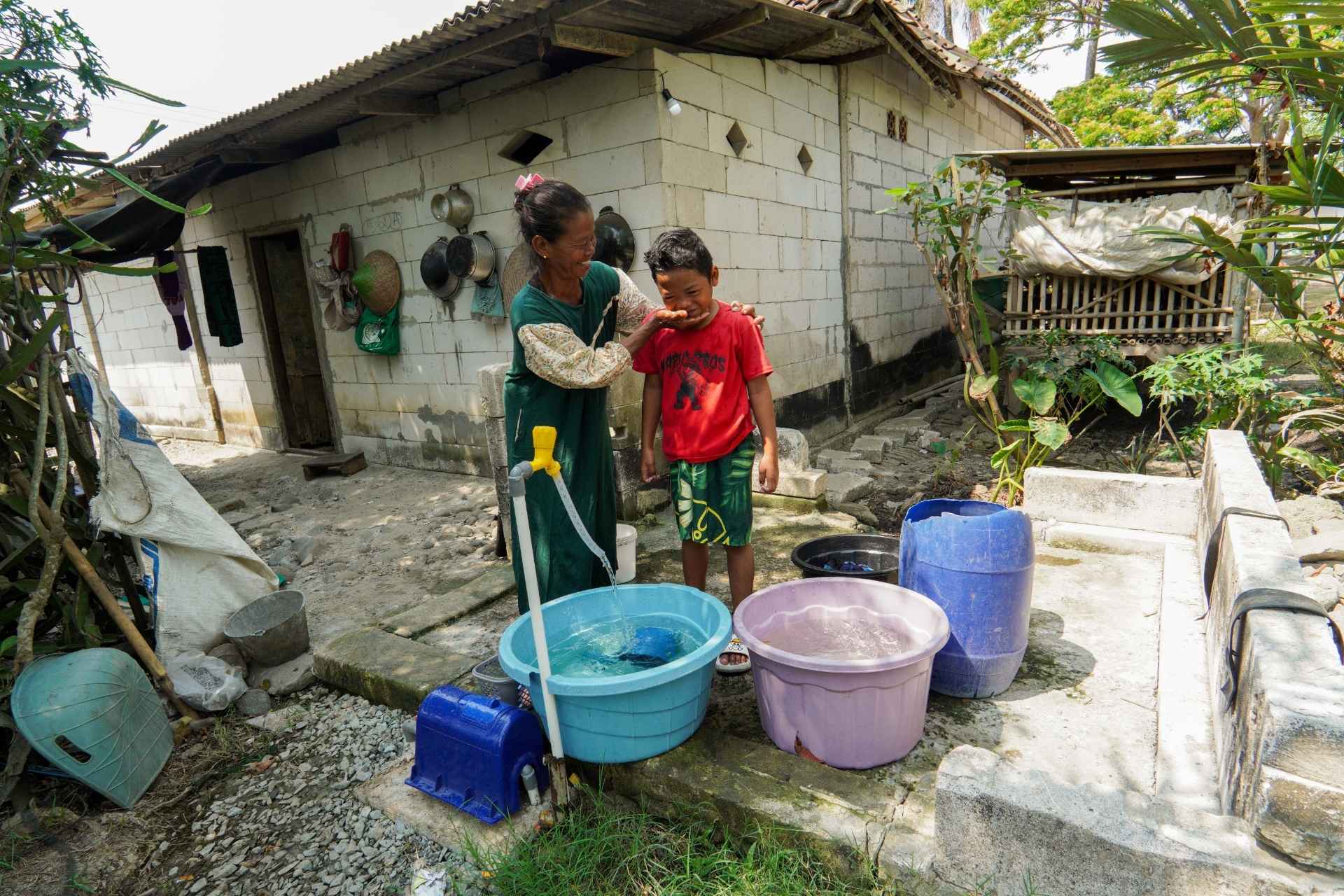
Nenih washes her grandchild’s face with clean running water installed at her home, thanks to support from Habitat for Humanity in Baturaden Village, Karawang Regency. Photo: HFHI/Kevin Herbian
For Nenih, access to clean water has also brought new hope for her family’s health. Previously, using water from the irrigation canal was often followed by complaints of itchy skin. Now, she feels more at ease knowing that her family can carry out their daily activities using cleaner and safer water.
She has even started using the water for consumption. “I tried using this water for cooking and making coffee. It tastes very good. Now I feel much more at ease because I can use clean water,” she said.
Access to clean water has also brought economic benefits. Previously, Nenih had to set aside around IDR 150,000 every month to purchase refillable drinking water. With access to a clean water supply, this expense is no longer as much of a burden as it once was.
For families with limited incomes, these savings create more room to meet other needs. Money that was previously spent on purchasing water can now be saved or allocated to other household expenses.
After 61 years of living with limited access to clean water, Nenih can finally experience something she had never had before: safe and adequate water that she can use without having to travel far from home.
“This is such a great blessing for me. I never imagined that at my age I would finally be able to have clean water available near my home. In the past, every time I needed water, I had to think about where to get it. Now, I can use it much more easily,” Nenih said.
However, Nenih’s happiness does not end with what her family is experiencing today. She hopes that the newly built water facility will be properly maintained and cared for so that its benefits can last for many years to come.
“I hope this water facility will continue to be looked after and maintained so that its benefits are not only enjoyed today, but can also be used by my children and grandchildren. I also hope that other neighbors who do not yet have access to clean water will one day be able to experience the same benefits that I have,” she said.
Writer: Kevin Herbian
(kh/av)