Stories of Change
Karawang, September 16, 2026 – For some families, the morning may begin with preparing breakfast and making sure the children are ready for school. But for Sami (53) and her family, mornings once began with a much more basic question: where would they get water to bathe that day?
In Baturaden Village, Batujaya Subdistrict, Karawang Regency, access to clean water is more than just a household necessity for Sami and her family. Its availability determines how her children start their day, whether they can get ready for school comfortably, and how much money the family has to set aside each month.
Sami earns a living by selling snacks and refreshments for children in front of her home. From this small business, she earns around IDR 50,000 a day. Her husband, Caplin (55), works as a farm laborer and earns approximately IDR 1.5 million per month. With limited household income, every expense has to be carefully considered, including the cost of obtaining water that is safe and suitable for everyday use.
For years, Sami’s family relied on water from a well provided by the village government and shared by four families. The water was used for daily needs such as bathing and washing clothes. However, the water from the well tasted bitter, making it unsuitable for drinking or other consumption needs.
To meet those needs, Sami had to purchase refillable drinking water. The water was not only used for her family’s drinking needs, but also to make iced beverages that she sold in front of her house.
“Every month, I have to buy around 20 gallons. Each gallon costs IDR 5,000, so I spend around IDR 100,000 just on water. The water is used both for our family’s drinking needs and to make the drinks I sell. So, I really have to manage our expenses carefully to make sure we can still afford our other needs,” Sami said.
However, relying on the well did not always ensure that Sami’s family had enough water. When the dry season arrived and the well’s water supply decreased, Sami and her family had to take turns using whatever water sources were available. In certain situations, they were even forced to rely again on the irrigation canal, where the water was cloudy and unsuitable for everyday use.
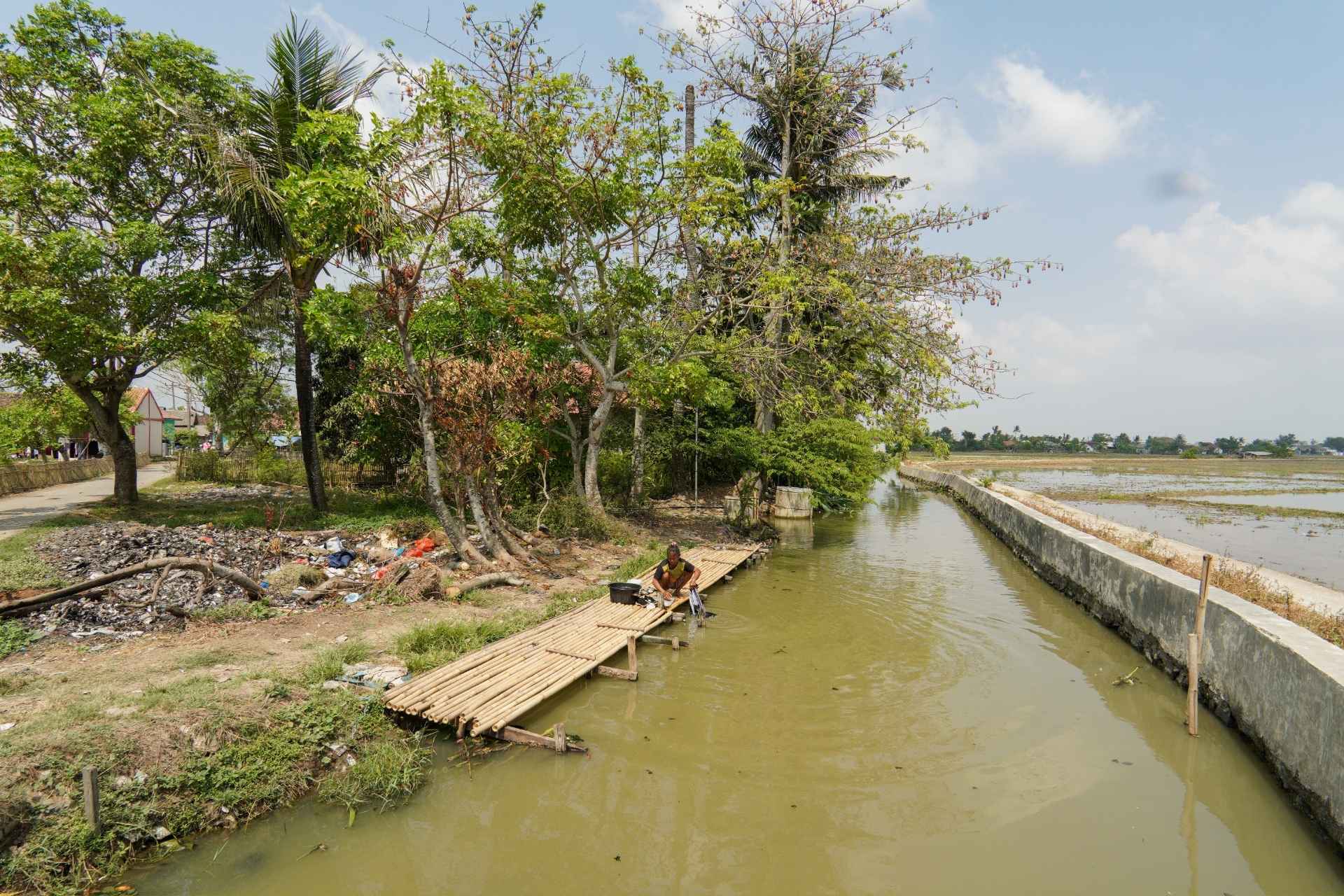
An irrigation canal used by Sami’s family and local residents to meet their daily water needs in Baturaden Village, Karawang Regency. Photo: HFHI/Kevin Herbian
For Sami, the situation became even more difficult when her children had to use the water to bathe before going to school. They often experienced itchy skin after using water from the irrigation canal. The situation also affected their comfort as they went about their daily activities, including attending school and studying.
“In the past, almost every morning after dawn prayers, my children would bathe in the canal before going to school. They were actually uncomfortable because they had to bathe in an open area and were afraid that people might see them. On top of that, their skin often felt itchy afterward. As a parent, it was heartbreaking to see my children having to go through that,” Sami said.
Water, which should be one of the most basic necessities of everyday life, had instead become a source of concern for Sami’s family. Limited access to water was not only about drinking or bathing. It also affected their health, comfort, privacy, and the children’s ability to start their day and attend school without unnecessary difficulties.
The situation began to change when Habitat for Humanity Indonesia, together with Habitat for Humanity Netherlands, developed a clean water supply system using water from the local irrigation canal. The water is treated through a filtration system before being distributed to 10 priority families who previously faced limited access to clean water, including Sami’s family.
To ensure that the water was safe to use, the filtered water was also tested in a laboratory. This process was an important step in ensuring that the water quality met the required standards before being used by the families.
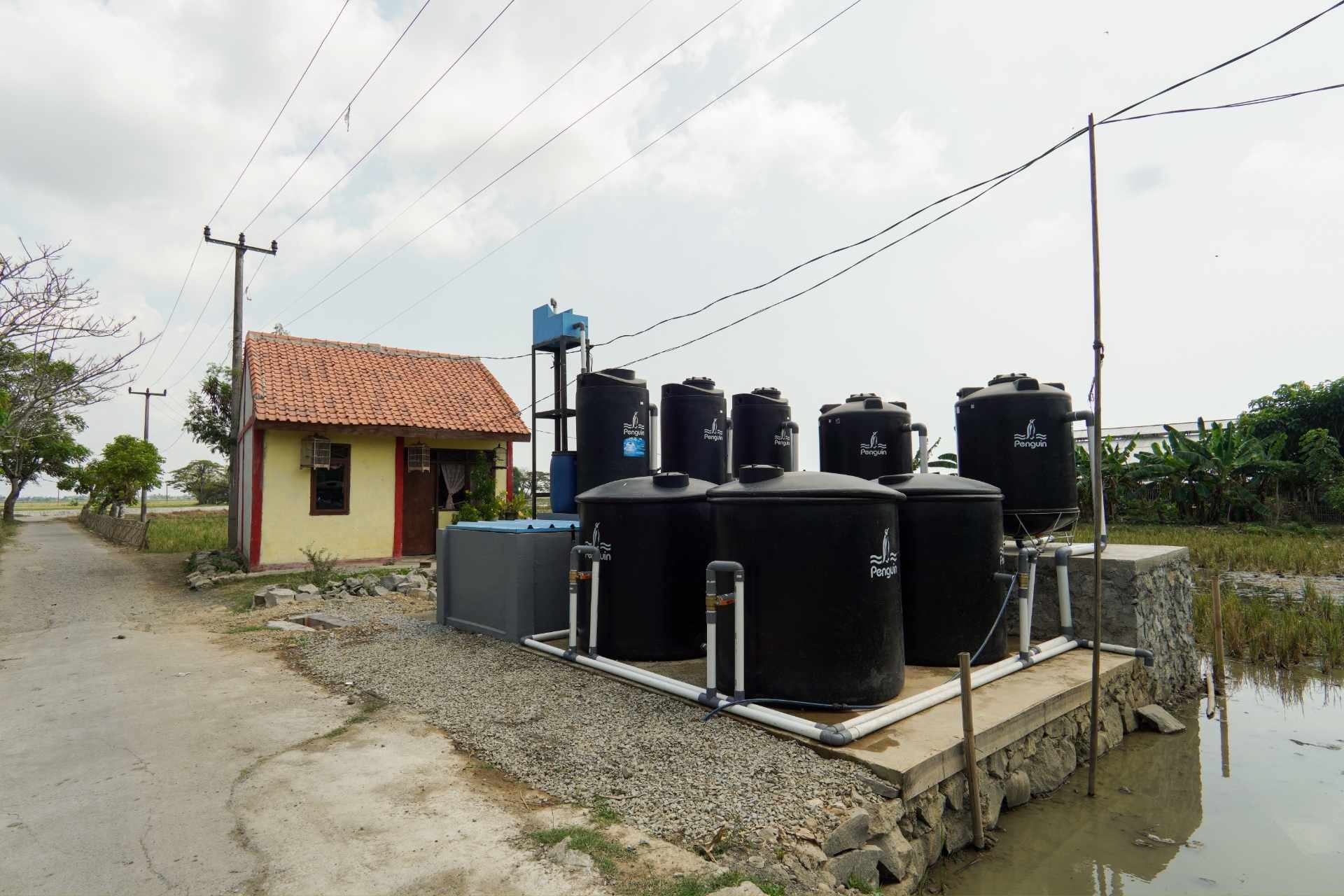
An irrigation water treatment and filtration facility established by Habitat for Humanity Indonesia to produce clean water in Baturaden Village, Karawang Regency. Photo: HFHI/Kevin Herbian
Now, after using water from the new system for around two weeks, Sami is experiencing changes that she once found difficult to imagine. Water that she previously had to search for, conserve, or purchase is now available for various household needs.
“Alhamdulillah, we now have a new water source. We no longer have to struggle to find water or worry when the dry season comes. The water is also much better than what we used before. Our skin no longer feels rough after bathing,” she said.
The most noticeable change for Sami has been in her children’s lives. They no longer have to go to the irrigation canal to bathe before going to school. They no longer have to worry about bathing in an open area or using water that causes their skin to itch.
“What makes me happiest is seeing my children being able to bathe with clean water. Their skin is no longer like it used to be, when it often became itchy after using water from the canal. They are more comfortable now and can go to school without having to worry about things like that,” Sami said.
For the children, the change may seem simple. But for Sami, being able to bathe with clean and safe water means much more than comfort. It gives her children a greater sense of safety and privacy, as well as the opportunity to go about their daily activities in better conditions.
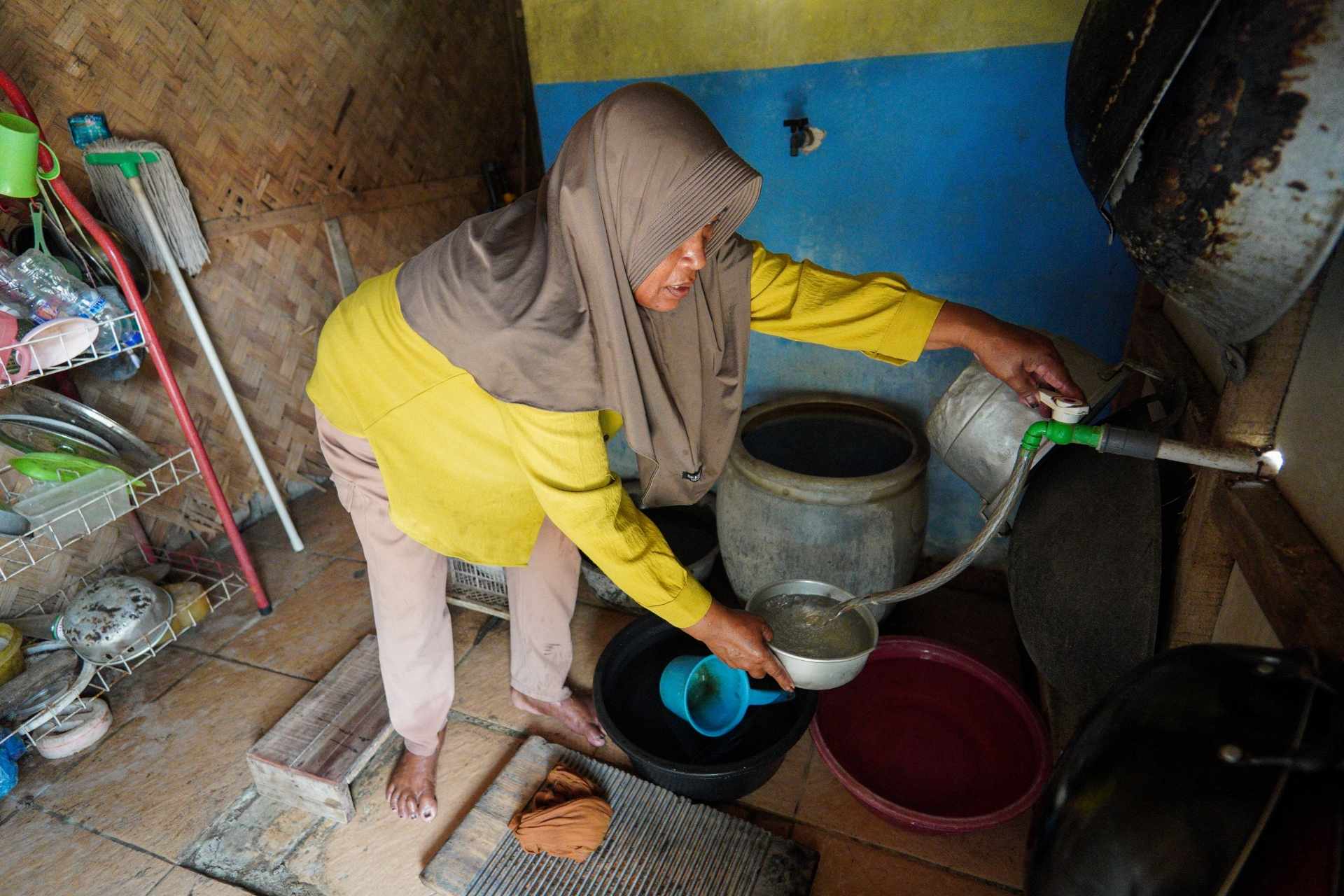
Sami uses clean running water at home for her daily needs, including preparing water to sell ice treats in Baturaden Village, Karawang Regency. Photo: HFHI/Kevin Herbian
Clean water has also brought changes to Sami’s livelihood. Until now, part of the money she spent on refillable drinking water was used both for household needs and to support her small business selling beverages. With the new water source, her reliance on purchased water has begun to decrease.
“The water is also good for drinking. The biggest difference is that we no longer need to buy refillable water as often. It also makes things easier for my business because the water we need is already available. That means I can save some of the money that I would normally spend on water,” Sami said.
Sami has not yet been able to calculate exactly how much additional income she has gained from the new water supply system, as she has only been using it for around two weeks. However, for her, simply reducing the amount she spends on purchasing water is already meaningful support for her family.
Amid the dry season, when water availability has become a challenge for many families in the surrounding area, Sami no longer faces the dry months with the same level of worry. Together with nine other families in Baturaden Village, she is beginning to experience how improved access to water can transform many aspects of everyday life.
Because clean water is about more than simply having water flow from a tap. It means better protection of children’s health, the opportunity to go to school more comfortably, reduced household expenses, and a small business that can operate with less financial pressure.
More broadly, access to clean water is an inseparable part of a decent home. A safe and comfortable home is not defined solely by strong walls and a sturdy roof. Families also need access to basic services that enable them to live healthy lives, maintain hygiene, and carry out their daily activities with dignity.
Writer: Kevin Herbian
(kh/av)