
Habitat Updates
Gunungkidul, July 9, 2026 – “I used to think gender referred only to a group of widows. I was once invited to join a group that called itself a gender group. I wondered, ‘I thought gender meant widows, so why is this woman included when she isn’t a widow?’ That was my first understanding of the term. It turns out I was wrong,” said Agus Suwarjo, Head of Pengkol Village, Nglipar District, Gunungkidul Regency, during his opening remarks at the Sinau Bareng Warga: Gender Equality, Disability, and Social Inclusion (GEDSI) Mainstreaming event held at the Pengkol Village Hall.
The concepts of gender and GEDSI are still relatively unfamiliar in Pengkol and the wider Nglipar area, particularly among participants of the Sinau Bareng Warga program. Some participants initially understood gender simply as the biological difference between men and women.
“As far as I knew, gender was just the difference in sex between men and women before I joined this activity,” said Iqbal Nur, a representative of the local Youth Organization (Karang Taruna) and one of the 15 participants.
After participating in the Sinau Bareng Warga: GEDSI Mainstreaming program—a collaboration between Habitat for Humanity Indonesia, SPEK-HAM, and SAPDA through the ACCESS Program—Iqbal gained a broader understanding of the concept. He learned that gender is a social construct associated with men and women, with roles and expectations that are shaped by society and can change over time.
Iqbal also shared that the training helped him realize that everyone has equal rights and equal opportunities, regardless of whether they are men or women. While biological sex cannot be changed, the social roles and expectations assigned to men and women are shaped by society and can evolve.
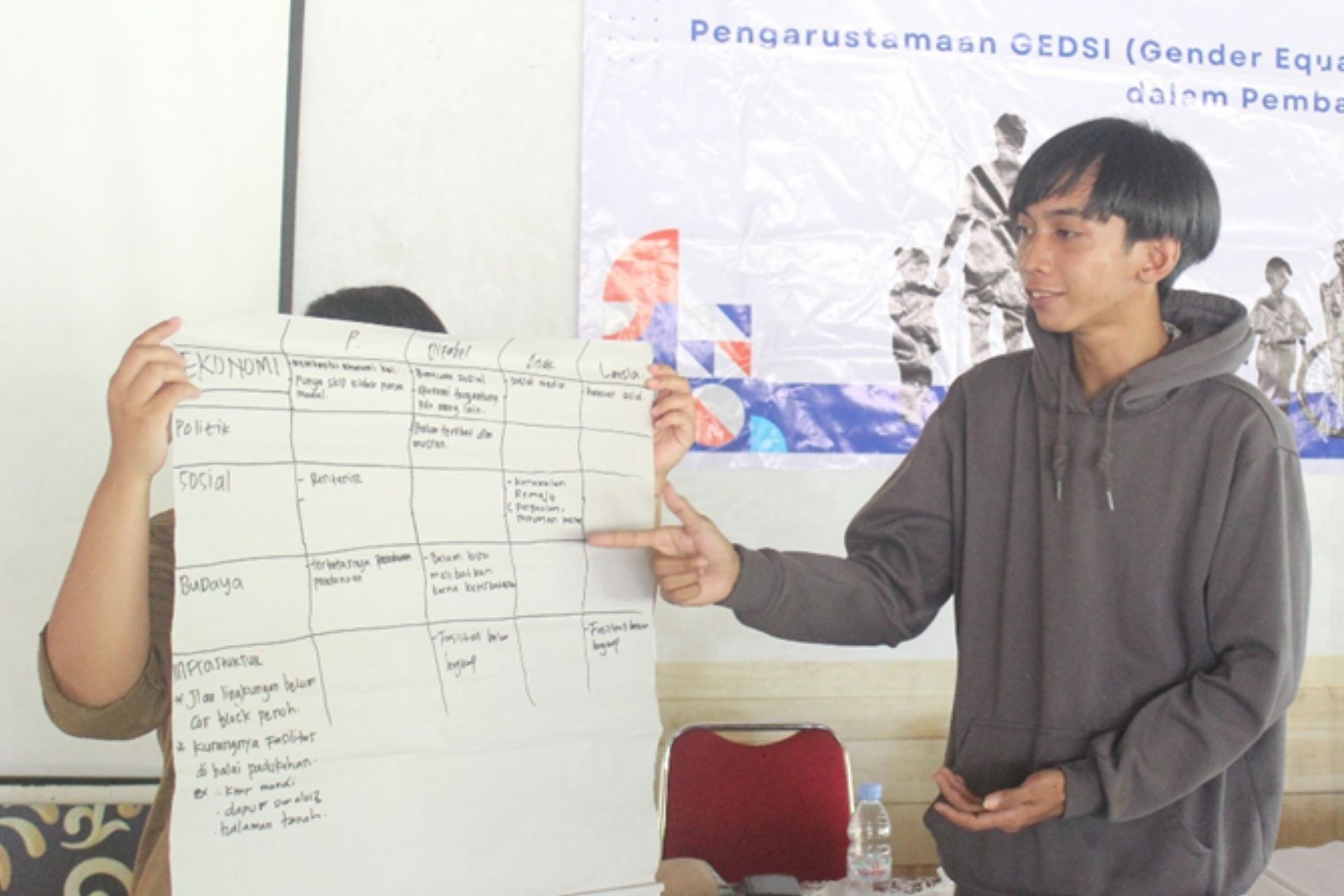
Participants of the Sinau Bareng Warga program present the results of mapping the challenges and potential of their villages in Gunungkidul Regency, Indonesia.
Read also: Promoting Inclusive Development at the Community Level Through Shared Learning Spaces
In the context of development, Amin Nurohman, one of the resource persons for the Sinau Bareng Warga sessions held in Pengkol and Pilangrejo Villages, explained that understanding gender means recognizing that both women and men should have equal opportunities to participate in and benefit from development.
“When it comes to development, there should be equal economic opportunities. If assistance is provided, everyone should have equal access to it. If roads are built, both women and men should equally benefit from safe and reliable infrastructure,” Amin explained.
The same principle applies to access to clean water. Both women and men have the equal right to access and benefit from clean water services.
The participation of representatives from various community groups in Nglipar—including the Women’s Farmer Group (KWT), the Family Welfare Movement (PKK), the Youth Organization (Karang Taruna), disability groups, the Empowerment of Women Heads of Households (PEKKA), hamlet heads, vulnerable groups, and other community organizations—is expected to strengthen the identification of both community challenges and local potential. Their active involvement also provides valuable input to village development planning forums, enabling local governments to promote more inclusive and equitable development for everyone.
Photo & Writer: SAPDA/Wulan Dwi
(av/kh)